|
London Transport=London Terror
|
"It is unreal, like you are watching it happening elsewhere."
- Eyewitness Janice Dyson
|
PURE THEATRE:
conflicting reports: Eyewitnesses say small explosion, like a smoke bomb
Cops say NO explosions...erm....that were 'almost simulataneous'
"The four bombs placed throughout the city only had the detonators explode and not the bombs themselves."
How likely is it that all four bombs would fail to detonate?
|
"Clearly the intention must have been to kill. You do not do this with another intention."
"I think the important thing is that the intentions of the terrorists have not been successful." - Metropolitan Police Commissioner Sir Ian Blair
|
"We know why these things are done. They're done to scare people and to frighten them, to make them anxious and worried," PM Tony Blair
|
|
Timeline of London's latest attacks
21/07/2005 - London - Here is a timeline of the bombings that rocked London's transport system on Thursday, but only caused one injury.
Police have yet to confirm the exact order of events and offer further details.
The explosions took place exactly two weeks after four suicide bombers killed 52 people on subway trains and a bus in the British capital.
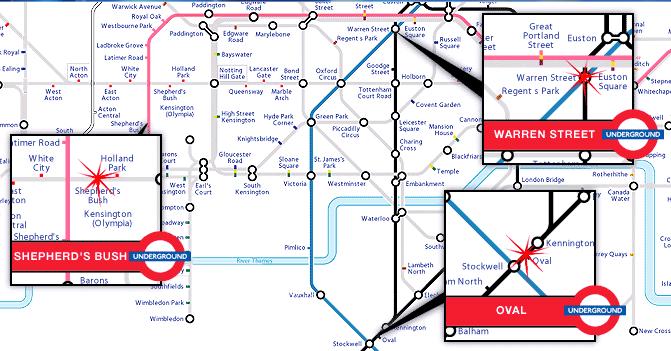
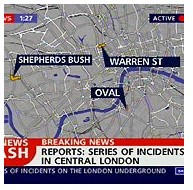
12:25 (11:35 GMT) - Police evacuate Shepherd's Bush subway station, north London, on the Hammersmith and City line following an attempt to set off an explosion.
12:30 - Emergency services are first called to Oval subway station, south London. About 20 or 30 passengers are evacuated from a London Underground train saying that they had seen "white smoke". There are also reports of a man dumping a rucksack in a carriage then fleeing as the doors closed.
12:45 - London ambulance service sends five vehicles to Warren Street subway station, north London, after reports of a rucksack exploding on a train in a tunnel just outside the station.
13:15 - Pubs and offices near Warren Street station are evacuated.
13:22 - London Underground says it has suspended services on the Hammersmith and City, Victoria and Northern lines.
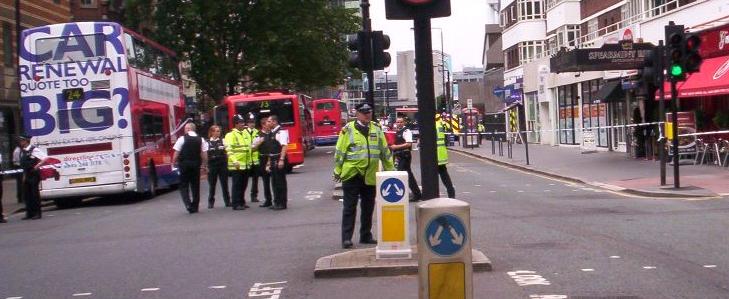
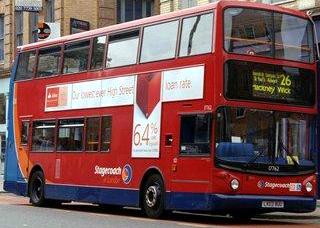
13:30 - The driver of the number 26 bus reports hearing a bang followed by a smell of smoke coming from the upper deck while driving along Hackney Road, Shoreditch, east London. Upstairs he finds the windows blown out.
13:45 - Transport for London confirms it has imposed a Code Amber at all three affected subway lines which means trains are taken to the next station and passengers evacuated to above ground.
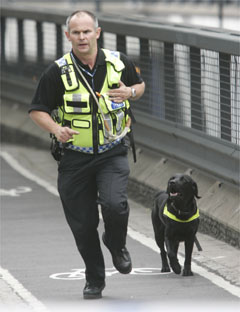
13:45 - Police with sniffer dogs comb the pavement along Euston Road, near Warren Street and the surrounding area.
2:24 pm - Metropolitan police confirm armed officers have been deployed to University College Hospital where they are dealing with an incident.
14:30 - London police chief Ian Blair confirms bombs exploded, urges Londoners to stay calm and stay put.
14:40 - An initial examination at Oval shows that there is no trace of chemical agents.
14:45 - Downing Street confirms the government's civil contingencies committee - known as Cobra - would be meeting in response to the latest incidents.
15:10 - London Underground says the Piccadilly and Bakerloo lines have also been suspended as a security measure as no incidents have been reported on those lines.
15:20 - British transport police confirm no trace of chemical agents have been found at Warren Street station following the incident there.
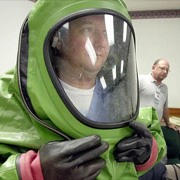
15:25 - London fire brigade says officers are deployed at Warren Street London Underground station in full protective equipment as a precaution in order to examine the scene.
15:30 - British Prime Minister Tony Blair tells reporters the incidents were "serious" and designed to "scare people and to frighten them".
15:50 - London police chief Ian Blair says the situation is "fully under control" and confirms that there was one injury in the blasts.
16:00 - Armed police and dog handlers arrive at Shepherd's Bush to begin searches of streets that had earlier been sealed off.
16:10 - Police confirm no traces of chemical agents found at the four sites.
16:10 - Police chief Blair says the explosions were "pretty close to simultaneous" but that not all of the devices went off properly.
|
|
|
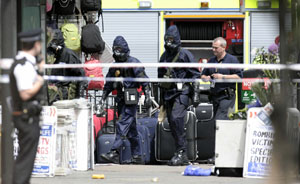
"...witnesses reported seeing men in chemical suits going down into the station. "
|
|
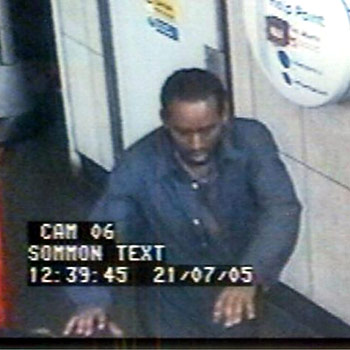
"Police were last night searching a London hospital for a man wearing a blue shirt with wires protruding from the back."
|
"At Oval station there were reports of a man dumping a rucksack in a carriage then fleeing as the doors closed."
|
"Passengers were screaming `get him, get him' at a man with a rucksack, which had burst into flames."
|
"A witness said he saw one blast come from the backpack of a man who appeared to be Italian. He fled the train."
|
|
"... in east London, according to the bus company's spokesman. the windows of the bus were blown out..."
|
"Television shots showed the windows on the top deck blown out, and a bomb-sniffing dog on the scene."
|
"I have seen the bus. There were no windows blown out," Police to Reuters.
|
|
Friday 22nd July, 2005
London reels from new explosions on trains, bus
Thursday 21st July, 2005 - Four midday explosions aboard London subway trains and aboard a bus had London reeling Thursday, two weeks after a similar attack.
Three downtown subway stations were evacuated when small explosions occurred, filling one station with smoke. There were unconfirmed reports one person was injured, the BBC said.
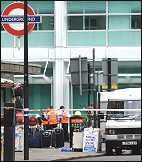
Police cordoned off the area around the Warren Street, Oval and Shepherd's Bush stations.
A witness said he saw one blast come from the backpack of a man who appeared to be Italian. He fled the train.
The underground system was placed on red alert, and all trains were stopped.
In East London, a bus driver reported hearing a bang from the upper deck of his bus, prompting police to cordon off a neighborhood. Television shots showed the windows on the top deck blown out, and a bomb-sniffing dog on the scene.
"Clearly, this is a very serious incident," Metropolitan Police Commissioner Ian Blair told reporters.
The incidents come two weeks to the day after four suicide bombers detonated knapsacks on three subway trains and a bus, killing at least 56 people.
Big News Network.com
|
BOMBS SHUT DOWN LONDON
String of explosions create panic
police evacuate three London Underground stations and cordoned off a bus with shattered windows?
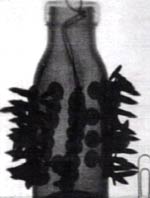
One person was injured after a suspected nail bomb detonated inside Warren Street train station, in central London?
A separate explosion also rocked a No. 26 bus in the Hackney area of east London, reportedly blowing out the windows of the top deck.
Two other central London stations, The Oval and Shepherd's Bush also evacuated and cordoned off, with police and firefighters placed on standby.
No chemical agents had been found.
Metropolitan Police Commissioner Ian Blair - "We know we had four explosions or attempted explosions," he said.
"At the moment, the casualties appear to be very low - the bombs appear to be smaller than on the last occasion."
Police were last night searching a London hospital for a man wearing a blue shirt with wires protruding from the back.
British Prime Minister Tony Blair appealed for calm...
Passengers aboard a tube train at Warren Street said they saw a man dump a bag inside a carriage seconds before it exploded.
"Someone came into the carriage dropped the bag and ran out, people tried to stop him, but he made off," said one passenger.
"(It) sounded like a champagne corking. I feel a bit shaken."
Another passenger, Adrian Williams, travelling on the northern line near Warren St, described how everyone got up and rushed to the back of the carriage.
"There was a big kerfuffle," he said. "Passengers were screaming `get him, get him' at a man with a rucksack, which had burst into flames."
Another passenger said how about 30 passengers were inside the carriage when the blast occurred. "I was in the next carriage and I could detect smoke," he said. "As we were heading on the Victorian line towards Warren St, the carriage behind mine, the interconnecting doors burst open and a rush of people came bursting in. There were about 30 people. It wasn't nearly as bad as it could've been.
"People were extremely frightened. You could see it in their haste to get away. There was no way of getting away, except to the next carriage. Some people were falling over and being pushed."
Victoria Line passenger Ivan McCracken said he heard a traveller's rucksack had exploded on the tube outside Warren Street station.
"I was in a middle carriage and the train was not far short of Warren Street station when suddenly the door between my carriage and the next one burst open and dozens of people started rushing through. Some were falling, there was mass panic.
"When I got to ground level, there was an Italian young man comforting an Italian girl who told me he had seen what had happened. He said that a man was carrying a rucksack and the rucksack suddenly exploded. It was a minor explosion, but enough to blow open the rucksack.
"The man then made an exclamation as if something had gone wrong. At that point, everyone rushed from the carriage."
Another witness on the same line, Abena Adofo, 23, said people were running into her carriage.
"I could just smell smoke and I saw lots of people panicking. I was just trying to be calm and get out. The smell of smoke was coming from the end of the carriage," she told Adofo.
The bus blast rocked a double decker bus travelling from Waterloo to Hackney in the east of city. The incident occurred in the Shoreditch area, a bus company spokesman said.
"The driver heard a bang he believed came from the upper desk of the bus. The windows were blown out. There are no reports of any injuries," he said.
In a late development, police escorted a man away from Downing Street as Mr Blair prepared to make a statement.
A police officer near the end of the street drew a firearm and aimed it at a target beyond the range of television cameras. Another officer then led away a man whose black shirt was undone. The man also wore black trousers and appeared to be of Asian or Middle Eastern origin.
source
'This is London' Message Boards...
|
UK police: Latest bombers failed
Thursday, July 21, 2005 Posted: 1932 GMT (0332 HKT)
LONDON, England (CNN) -- Two weeks to the day after the July 7 London bombings, attackers tried -- and failed -- to set off explosive devices at three Tube stations and on a double-decker bus.
Police said evidence left behind in Thursday's attempted bombings has given them what may be a "significant breakthrough" in their investigation. Metropolitan Police Commissioner Ian Blair told reporters the intention of the terrorists "must have been to kill" and that some of the devices failed to explode. Blair said investigators were analyzing forensic material found at the sites "which may be very helpful to us."
There are reports of one person wounded, although ambulance services said they did not transport anyone from the scenes.
Blair said while the near-simultaneous attacks had echoes of the ones two weeks ago that killed 52 people and the four bombers -- also on three Tube trains and a bus -- it was too early to say whether they bore the hallmarks of al Qaeda.
He stressed that the investigation was still at an early stage and cautioned against the "enormous amount of speculation" concerning the incidents. The police chief confirmed there were four scenes -- at Oval, Warren Street and Shepherd's Bush Underground stations and on a bus in east London -- where "attempts have been made to set off explosive devices." He told a news conference in central London: "Clearly the intention must have been to kill. You do not do this with another intention.
"I think the important thing is that the intentions of the terrorists have not been successful."
All three Tube stations were evacuated and the three affected lines -- Hammersmith & City, Victoria, and Northern -- were closed along with the Bakerloo and Piccadilly lines.
Police also said they deployed armed officers to investigate an "incident" at University College Hospital, near Warren Street, where an explosive device went off aboard a train. The central London hospital confirmed the situation there was over, although it is not clear what prompted the alert.
Witnesses reported policemen with flak jackets entered the hospital along with dogs, and said police searched a man with a red backpack and took him away, without handcuffs. People in buildings near the hospital were not allowed to leave their offices during the incident. A Scotland Yard spokesperson also said two arrests were made in the Westminster area but said they were not necessarily linked to the attacks.
At a news conference, Prime Minister Tony Blair praised the police operation and urged Londoners to remain calm.
"We know why these things are done. They're done to scare people and to frighten them, to make them anxious and worried," he said. The prime minister, who referred questions on operations to police and emergency services, told reporters: "Police and security services are pretty clear about what's happened.
"The police have done their very best and the security services, too, in this situation. And I think we just have got to react calmly and continue with our business as much as possible as normal." Blair appeared with visiting Australian Prime Minister John Howard, who praised the resolve and bravery of the British people.
Amid the massive security alert across the British capital, armed police were seen on television drawing their guns near Blair's official Downing Street residence as they detained a man. There was no indication the man was linked to the blasts.
In the United States, the White House said President George W. Bush was informed of the incidents.
Bus 'bang'
News of the incidents first came at 12:38 p.m. (7:38 a.m. ET). At 12:45 p.m., a call came in from Warren Street.
The area around Warren Street station was sealed off while the bomb squad checked for further explosive devices.
Authorities pushed people back from the station, and witnesses reported seeing men in chemical suits going down into the station.
Police later said after initial checks that no trace of chemical agents was found at any of the stations.
Meanwhile in east London, a bus driver reported a "bang" from the top of his double-decker in Hackney, according to the bus company's spokesman. The spokesman said the windows of the bus were blown out, although this was denied by a police officer at the scene.
"I have seen the bus. There were no windows blown out," the officer told Reuters. At Oval station there were reports of a man dumping a rucksack in a carriage then fleeing as the doors closed.
A witness told Sky News he heard a sound "like champagne popping" then passengers erupting in panic. (Witness accounts)
"As far as I know from what a lady at the top of the escalator was saying, someone came into the carriage, dumped the bag and ran out. Some people tried to stop him but he ran out."
He said: "I was in the carriage next to the one where the bag was. All of a sudden there was a popping, it sounded like champagne popping. I didn't think anything of it at the time but then I heard a lot of shouting from the next door carriage.
"People started saying, 'Smoke, smoke.' One of the train guys came through and said 'Get off the train, we're evacuating, everyone out.' "As we were walking past the carriage we could see the bag sitting on the chair. It was a big, black rucksack, like the backpack-type ones that you get. "When they got upstairs, people were really distressed, one lady was crying."
Three small rooms in an unoccupied part of University College Hospital remained cordoned off Thursday night, the UK's Press Association reported. In a statement the hospital said: "Police have confirmed that there is no danger to patients or staff.
"Armed police conducted a search of the hospital this afternoon following the terrorist incident at Warren Street tube station and this search has now been completed. "Three small rooms in an unoccupied part of the hospital have been cordoned off and police inquiries are still continuing. "We are canceling routine appointments and surgery tomorrow for patients not already in the hospital."
One explosives expert told CNN the "sour smell" reported by people coming out of the Underground would likely have come from two sources: a rucksack catching fire; and explosives themselves catching fire after a detonator failed to explode them. The explosives could actually burn and give a toxic smell.
- CNN
|
Like Clockwork Abu Hafs al Masri Brigade
take responsibility for a 'failed bombing'
Abu Hafs al Masri Brigade claims responsibility for London blasts
The statement posted on an Islamic Web site says "We will strike in the hearts of European capitals, in Rome, in Amsterdam and in Denmark where their soldiers are in still in Iraq".
A statement posted Friday on an Islamic Web site in the name of an al-Qaida-linked group claimed responsibility for latest blasts targeting London's transport system. The group, Abu Hafs al Masri Brigade, also claimed responsibility for the July 7 bombings that killed 52 people and four suicide bombers.
The statement's authenticity could not be immediately verified and there has been doubt cast over the veracity of the group's past claims.
"Our strikes in the depths of the capital of the British infidels our only a message to other European governments that we will not relent and sit idle before the infidel soldiers will leave the land of the two rivers," said the statement.
The "two rivers" in the statement refer to Iraq's Euphrates and Tigris rivers. On Tuesday, another statement was issued in the name of the same group threatening to launch "a bloody war" on the capitals of European countries that do not remove their troops from Iraq within a month.
"While we bless these strikes, our next attacks will be Hellish for the enemies of God," said the latest statement. "We will strike in the hearts of European capitals, in Rome, in Amsterdam and in Denmark where their soldiers are in still in Iraq pursuing their British and American masters," the statement added.
The Abu Hafs al Masri Brigades are named after the alias given to Mohammed Atef, Osama bin Laden's top deputy who was killed in a U.S. airstrike in Afghanistan in November 2001.
Experts have said that the group has no proven track record of attacks, and note it has claimed responsibility for events in which it was unlikely to have played any role, such as the 2003 blackouts in the United States and London that resulted from technical problems. - eitb24.
|
|
CCTV in hunt for failed bombers
22 July 2005 - CCTV footage could hold the key to catching the four bombers behind Thursday's failed attempt to cause more carnage in the capital.
As Londoners went back to work after another day of transport chaos, police were scouring footage from cameras at the scenes in the hope of identifying the attackers.
They were also using the accounts of witnesses - some of whom tried to tackle the bombers as they fled - to build up a picture of what happened. All four attackers fled after their bombs failed to detonate - and a major hunt was under way to catch them before they can strike again. But detectives have a major advantage in comparison with the July 7 attacks as the four devices, which were contained in rucksacks, have been recovered this time.
Forensic experts will try to establish whether there was a link with the explosives found in West Yorkshire in the wake of the July 7 suicide bombings in the capital. Metropolitan Police Commissioner Sir Ian Blair said the intention of the suspects "must have been to kill".
No one was seriously hurt in Thursday's incidents.
Three of the four devices were thought to be of a similar size and weight to the bombs used in the July 7 attacks in the capital. The fourth was smaller and appears to have been contained in a small plastic box. An initial examination of the devices showed they contained constituents which appear similar to the explosives found in a bath at a property in West Yorkshire.
Police believe they represent a serious attempt to detonate explosives on the London transport network in a similar way to the bombing which killed 56 people and injured hundreds. - this is london
|
|
Police reveal bombing suspects
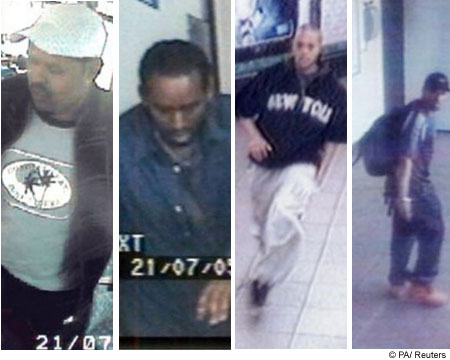
22/07/2005 - 16:18:38 - Police have revealed the faces of four men wanted for questioning in connection with the attempted suicide attacks in London yesterday. It was unclear whether the man shot dead at 10am this morning by plain-clothes firearms officers was one of those pictured.
But at least three of the men were tonight still on the run as detectives feared they were bent on launching further attacks.
London was on a state of alert as there were security scares across the capital.
Police raided an address in West Kilburn which was believed to be connected to one of the men but no one was arrested. Two further addresses were also being searched.
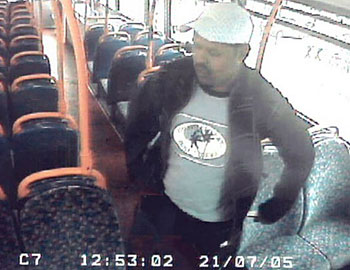
One CCTV image showed a man on the top deck of the number 26 bus travelling from Waterloo to Hackney Wick on which a rucksack bomb was found yesterday.
The suspect was wearing a grey t-shirt with a palm tree design and a dark jacket with a white baseball cap.
He got off the bus at Hackney Road at approximately 1.06pm yesterday.
Scotland Yard assistant commissioner Andy Hayman warned members of the public not to approach the men under any circumstances.
He said: "These are four men we urgently want to trace in connection with attempts to detonate four explosive devices on the transport system in central London yesterday.
"It's crucial that detectives are able to question them about yesterday's events at the Oval, Shepherd's Bush and Warren Street London Underground stations and a route 26 bus in Hackney Road."
He urged anyone who believed they knew the identities of the men or their whereabouts to call the UK's anti-terrorist hotline.
Metropolitan Police Commissioner Ian Blair said the shooting of the man at Stockwell Tube station today was "directly linked" to anti-terror operations.
Mr Blair said his officers hunting the bombers were now facing "previously unknown threats and great danger".
And he repeated his call for all sections of society to help in the fight against terror. "We need the understanding and co-operation of all the communities," he said.
- IOL
|
Meanwhile... in The Big Apple...
|
Police to Search Bags on NYC Subways
By TOM HAYS Associated Press Writer
Jul 22, 5:11 AM - NEW YORK (AP) -- Alarmed by a new round of mass transit attacks in London, police in New York have begun random searches of bags and packages brought into the city's vast subway system and elsewhere.
The inspections started on a small scale Thursday in Manhattan and were to be expanded during Friday morning's rush hour - a development welcomed by some commuters.
"I'm not against it," Ian Compton, 35, a computer consultant, said at Grand Central Terminal in midtown Manhattan. "I think any measures for safety that aren't terribly intrusive are worth doing."
Officers, some with bomb-sniffing dogs, will stop people carrying bags as they enter subways, buses and ferries at various points in the city, police said. Anyone who refuses a search will be turned away, and those caught carrying drugs or other contraband could be arrested.
Police officials said they had considered taking the measure to thwart bombings for the past three years. Two terrorist attacks on transit targets in London forced their hand, said Paul Browne, the police department's chief spokesman.
Browne called it "the first time this regimen has been used in (New York's) transit system."
On Thursday, a cluster of officers was seen stopping five men over a 15-minute period as they entered the subway in Union Square at evening rush hour. In each instance, the officers peered briefly into their bags, then waved them through.
"If it serves a purpose, I'm OK with it," said one of the men, James Washington, 45, about being stopped.
Officials declined to specify where and how frequently the checks would occur or how long they would last. The NYPD already had doubled the number of officers who patrol the subway after the initial attack in London on July 7, at a cost of $2 million a week in overtime.
That explosion killed 52 people and four suicide bombers. On Thursday, four small explosions struck the London Underground and a bus in a far less bloody attack. The only reported injury was an asthma attack.
"We just live in a world where, sadly, these kinds of security measures are necessary," New York City Mayor Michael Bloomberg said. "Are they intrusive? Yes, a little bit. But we are trying to find that right balance."
The New York Civil Liberties Union warned that the new measures violate basic rights and could invite racial or religious profiling.
"The plan is not workable and will not make New Yorkers more secure but will inconvenience them as police go about finding a needle in a haystack," NYCLU executive director Donna Lieberman said.
New York's subways carry about 4.5 million passengers on the average weekday, according to the Metropolitan Transportation Authority. The system, the largest in the country, has more than 468 stations, most of which have multiple entrances, and during rush hours the flood of humanity in and out of key stations can be overwhelming.
William K. Williams, a 56-year-old Manhattan resident who rides the train every day, said the searches would frustrate New Yorkers.
"Sometimes you need to get to an appointment, you're running late and a cop stops you to delay you even further? That's going to create a mess," said Williams, who was carrying a briefcase outside the Brooklyn Bridge station of the subway.
Police Commissioner Raymond Kelly said passengers selected for searches will be approached by officers, who will ask them what they're carrying and request that they open their bags. Those who decline "can't enter the system," he said. - NY Post
|
The fake bombings a cover?
|
|
COLOURBLIND: BROWN SKIN = ASIAN = TERRORIST
CULTUREBLIND: "Foreign looking" = TERRORIST
|
|
5th Bomb???
|
London police say may have found abandoned fifth bomb
Sat Jul 23, 2005 8:36 PM BST
LONDON (Reuters) - Police hunting four men who attempted to bomb London's transport system last week said on Saturday they might have found a fifth device abandoned in the northwest of the city.
"An initial examination suggests that the object may be linked to devices found at four locations in London on July 21," police said in a statement, adding the object was found in bushes in the Wormwood Scrubbs area of the city.
When asked if that indicated the discovery of a bomb, a police source said: "I wouldn't dissuade you from thinking that."
Four bombs were partially detonated on three underground trains and a bus on Thursday, killing no one, but causing chaos exactly two weeks after suicide bombers killed 52 London commuters. - reuters
|
Bush: Thanks Tony! London the reason to renew USA Patriot Act
|
Bush sees London attacks as reason for Patriot Act
By Bill Sammonand Audrey Hudson THE WASHINGTON TIMES July 21, 2005
President Bush yesterday invoked the terrorist attacks in London as a compelling reason for Congress to renew the USA Patriot Act and for local governments to beef up security on mass-transit systems.
"As we saw in London, the terrorists are still active and they are still plotting to take innocent life," Mr. Bush told law-enforcement officers in Baltimore. "So my message to the Congress is clear: This is no time to let our guard down, and no time to roll back good laws."
It was the first time the president cited the July 7 London attacks, which killed at least 56 persons in the British capital's subway and bus systems, to bolster support for renewal of the Patriot Act. The U.S. House is scheduled to vote on the measure this week.
"The Patriot Act is expected to expire, but the terrorist threats will not expire," he said. "I expect, and the American people expect, the United States Congress and the United States Senate to renew the Patriot Act."
The London attacks also have prompted a re-evaluation of mass-transit security by Homeland Security Secretary Michael Chertoff.
"He took a look at the situation and said, 'Let's enhance our security and infrastructure points,'?" Mr. Bush said. "We're widening the use of explosive detection teams and nearly doubling the number of rail security inspectors."
The president also defended Mr. Chertoff's assertion to the Associated Press last week that local communities are responsible for protecting transit systems. City officials in San Francisco and Chicago professed shock that the federal government was not assuming that responsibility.
"Those who are going to be responsible for responding to an attack are at the local level," Mr. Bush said. "I think that makes sense to say to a mayor, 'If you've got a problem with your mass transit, here's a grant, and if you feel that's the best use of the money, use it there.'?"
Although the federal government has provided $14 billion since September 11 to train and equip local emergency workers to respond to terrorist attacks, city leaders and some members of Congress insist that job should be handled at the federal level.
"Michael Chertoff is a very smart guy, but I couldn't disagree more," said New York Mayor Michael R. Bloomberg.
Sen. Charles E. Schumer, New York Democrat, demanded that Mr. Chertoff apologize for putting the onus on local communities.
Mr. Chertoff said he does not want to load the nation's buses and trains with federal police. He emphasized that the federal government is moving to a risk-based management approach to focus limited federal dollars on the biggest targets.
"A fully loaded airplane with jet fuel, a commercial airliner, has the capacity to kill 3,000 people," Mr. Chertoff said. "A bomb in a subway car may kill 30 people.
"When you start to think about your priorities, you're going to think about making sure you don't have a catastrophic thing first."
The Bush administration views the federal government's primary role as the source of funding for local officials.
The federal government has been paying for New York's mass-transit protection since September 11, 2001, and the Homeland Security Department has provided an additional $2 million per week for transit safety in the wake of the London bombings. The state of New York has received nearly $300 million in grants for terrorism prevention programs, medical response and emergency management since 2002.
California has received more than $280 million for protective equipment and training for first responders. Illinois has received more than $100 million in grants issued from 2002 to 2004.
"We've increased federal homeland security funding by more than tenfold for firefighters and police officers and other responders," Mr. Bush said. "I mean, if we're asking you to be on the front line, we ought to help you." - washington times
|
|
U.K. politicians question proposed anti-terrorism law
Last Updated Tue, 26 Jul 2005 11:27:56 EDT CBC News
Opposition politicians in Britain say they're uncomfortable with a proposal to detain suspected militants without charge for three months. They met with Prime Minister Tony Blair Tuesday to talk about planned legislation designed to prevent more attacks such as the one that killed 56 people in London's transit system two weeks ago.
Police have proposed extending the time that a suspect arrested under the country's Terrorism Act can be held without charge from two weeks to three months.
"We see very considerable difficulties in that. That is a long time to hold someone without charge, and possibly just release them after that," Conservative leader Michael Howard told reporters.
Liberal Democrats leader Charles Kennedy agreed.
"We have to make sure that we go about this in a measured way and that we don't surrender basic civil liberties," Kennedy said. "We have reservations about a possible extension on holding people for questioning."
Politicians also discussed proposals to outlaw "indirect incitement" of terrorism, including praising those who carry out attacks. The law is aimed at extremist Islamist clerics accused of motivating disaffected Muslim youth in Britain to commit violence.
|
|
|
Under the proposed legislation, it would also be illegal to receive training in militant techniques in Britain or abroad, or to plan an attack. Getting bomb-making instructions from the internet would also be illegal. Despite their reservations about parts of the proposed legislation, opposition leaders expressed their solidarity in the fight against militant attacks.
"There's a great desire at a time when the country faces such great danger to work together. We are all in this together and we all believe it is very important to show that the country is united in its response to the danger we face," Howard said. "We hope that it will be possible to reach agreement on further measures that will enable us to deal with this threat more effectively."
Blair vows not to 'give 1 inch'
In a news conference after meeting with opposition politicians, Blair reiterated his determination not to link the London bombings with Britain's continued involvement in the Iraqi conflict.
"Of course people are going to use Iraq and Afghanistan ... to try to recruit and motivate people," said Blair. "But I think most people understand the roots of this go far deeper ... Whatever excuse or justification that people use, I think we shouldn't give one inch to them."
Blair also called the Sept. 11 attacks in the United States a "wake-up call." But he said the problem is the world "woke up for a short time and then went back to sleep again." cbc.ca
|
|
|
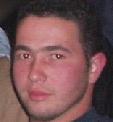
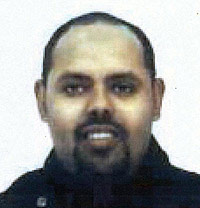
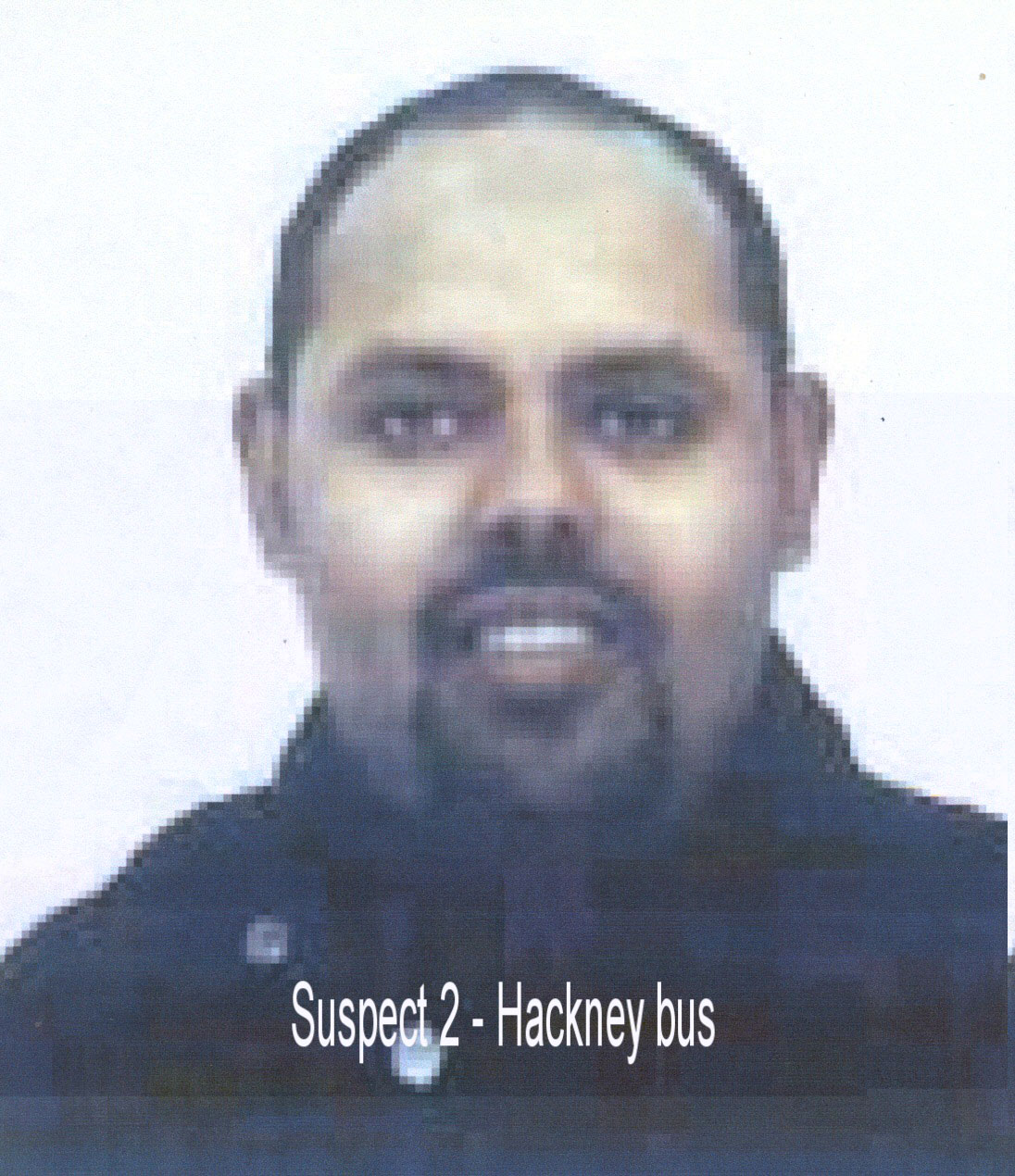
Yasin Hussan Omar, 24, arrived in Britain from Somalia in 1992, the Home Office said. He is suspected of trying to blow up a subway train near Warren Street station. Muktar Said Ibrahim, also known as Muktar Mohammed Said. Muktar Said Ibrahim, also known as Muktar Mohammed Said, 27, is a naturalized British citizen who arrived from Eritrea in 1992. He is suspected of trying to bomb a bus. Both men arrived in Britain as dependants of refugees and have been legal residents in the U.K. for more than 10 years .
London bombing suspects from Somalia, Eritrea
|
|
Car seized in London terror hunt
26/07/2005 - 14:43:46 Detectives investigating last week's attempted bomb attacks in London today seized a car thought to have been used by one of the bombers.
The car, a white VW Golf had been under surveillance, and was seized by officers in north London soon after 1pm. No arrests have been made and no explosives have been found in the vehicle so far.
It was seized in the Finchley area of north London, at the junction of Strawberry Vale and Chambers Gardens.
Part of the North Circular, the A406, between Finchley Road and Colney Hatch Lane, has been cordoned off. It is thought the vehicle may have been used by one of the four bombing suspects.
Two of the would-be suicide bomb suspects have been named by police as Yasin Hussan Omar and Muktar Said-Ibrahim, also known as Muktar Mohammed-Said.
Both men have been legally resident in the UK for more than 10 years.
Omar, 24, is a Somalian national who arrived in Britain aged 11 in 1992 as a dependant and was granted exceptional leave to remain in the country. In May 2000 he was granted indefinite leave to remain.
Ibrahim, 27, is a naturalised British citizen. He arrived in Britain from Eritrea as a dependant in 1992, aged 14, and was granted exceptional leave to remain.
In November 2003 he applied for naturalisation as a British citizen and was issued with his British passport in September last year.
Omar was staying at a north London flat, on the ninth floor of a 12-storey tower block in New Southgate. It is believed to have been used as a bomb factory by the suicide team who unsuccessfully targeted the London transport network last Thursday.
Explosives experts were today examining material found inside.
Today the cordon around their tower block flat was widened and police were searching lock-up garages nearby.
As the hunt for the bombers continued, Prime Minister Tony Blair met opposition leaders in Downing Street.
There have been no publicly confirmed sightings of the four bombers, who were captured on CCTV, since 1.05pm last Thursday when Ibrahim was seen getting off the 26 bus he had tried to blow up in Hackney Road, east London.
Detectives have no evidence they have left the country and believe they may all be hiding in a safe house in the capital.
They believe the bombers could have links with the suicide cell which carried out four bombings on the London transport network on July 7, killing 52 innocent people.
Meanwhile. the family of Jean Charles de Menezes, the innocent Brazilian electrician mistakenly gunned down by police, are in discussions with lawyers and may sue Scotland Yard.
IOL
|
Tasers used - couldn't wait to use those could they?
|
|
Four arrested in relation to attempted London blasts
27/07/2005 - 07:05:20 - Four men have been arrested at two addresses in Birmingham today by police investigating the failed bomb attacks in London on July 21.
Officers said all four men had been arrested under the Terrorism Act 2000 and that a suspect package was found during one of the raids, which occurred in the east of the city.
A police spokesman confirmed that one suspect had been shot with a Taser stun gun during one of the raids, although no firearms were discharged.
IOL
|
Terrorist - Asylum seeker linking continues
Vanishing bombers and the mystery 'safe house'
By Dominic Kennedy, Adam Luck and Daniel McGrory
July 26, 2005 - DETECTIVES leading Britain's biggest manhunt made a desperate plea for public help last night as it emerged that there have been no sightings of the four suicide bombers since they fled five days ago. Police named two of the men and released new pictures. Five people are being questioned but none is believed to figure strongly in the investigation.
None of the four main suspects has been seen since 1.05pm on Thursday, minutes after the bungled attacks. It emerged last night that the four attended Finsbury Park mosque, North London and that two received benefits to rent a council flat.
A Populus poll for The Times showed that 74 per cent of the public believe that terrorist bombings and scares are likely to be part of life in London in future. There is support for deporting foreign Muslims who encourage extremism while 70 per cent favour police powers to hold terrorist suspects for up to 90 days without charge.
|
|
|
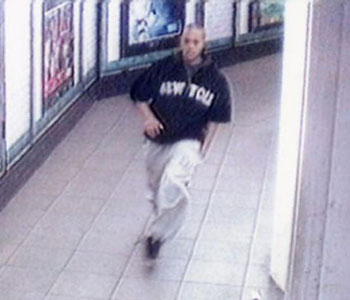
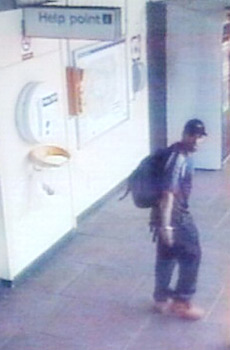
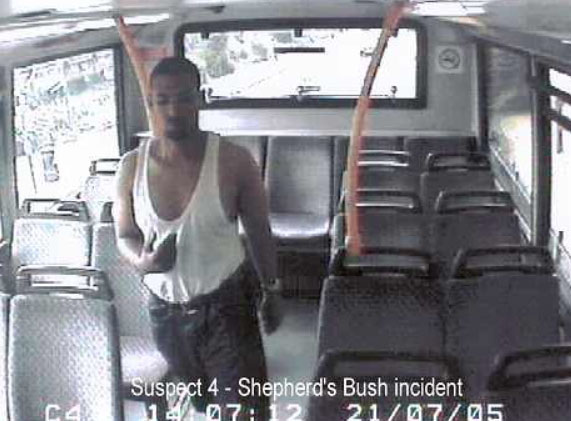
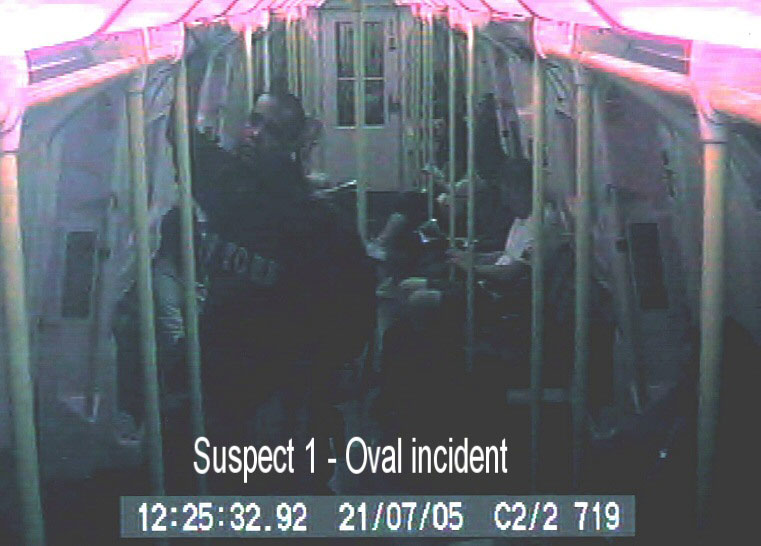
Police know that three of the bombers assembled at Stockwell Underground station before 12.25pm last Thursday. Scotland Yard released a remarkable photograph of an unnamed suspect staring up as he stands on a Tube train waiting for his bomb to blow up. The device made a harmless pop like a champagne cork before the train pulled into Oval station. At 12.35pm the man ran towards the exit, pursued by members of the public. He ran towards the centre of Brixton, throwing away his top with the "New York" logo in Gosling Way, and was last seen in Tindall Street at 12.45pm. Hundreds of officers have been checking the bombers' known addresses and questioning associates. Police believe that they are at a prearranged safe house in London and fear that they could be preparing more attacks.
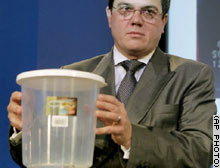
Officers spent last night searching the flat at Curtis House, a 13-storey block on a council estate in Bounds Green, North London, used by two of the bombers. Police believe that this is where the devices were assembled. They were packed in clear plastic 6.25-litre food canisters made in India, which are sold at only 100 outlets in Britain.
Scotland Yard named two of the suspects after previous appeals for help drew a disappointing response. They are the bus bomber, Muktar Said-Ibrahim, 27, thought to be Eritrean and who also uses the name Muktar Mohammed-Said, and Yasin Hassan Omar, a Somali, the Warren Street bomber. Both are thought to be asylum-seekers.
Omar, who was last seen vaulting a barrier at Warren Street station, has been the registered occupant of the flat since 1999. Ibrahim, who was last seen in Hackney Road, East London, after his failed attempt to blow up a No 26 bus, shared it with him for the past two years. Omar, received £88 a week in housing benefit to pay for the council property and also received income support, immigration officials say. Police are close to confirming the identity of the other two suspects and are trying to discover whether any of them attended any overseas training camps.
Officers were also understood last night to be interviewing Ibrahim's father, who lives in Stanmore, North London.
Sammy Jones, a mother of two, said that she recognised the men from photographs shown to her by detectives. "The man who I now know is called Muktar used to have a big bushy beard but he then shaved that off," she said.
Mrs Jones, 33, said that the group were seen carrying heavy cardboard boxes into Flat 58 on the ninth floor. Police are understood to have removed a fridge, possibly used to store the explosives.
Another neighbour, Vance Noor, 18, said that the bombers used to play for a Sunday football team of fellow Somalis.
- times online
|
|
British Police Arrest 4 in Failed Bombings
By CATHERINE McALOON Jul 27, 6:34 AM EDT - LONDON (AP) -- British police investigating a series of failed bomb attacks in London said they arrested four men Wednesday in the city of Birmingham, and explosives experts were examining a suspect package found during the searches. Police said they could not confirm reports that one of the four was a suspected attacker from July 21, when four bombs planted on London Underground trains and a bus failed to fully detonate.
A spokesman for the metropolitan police said one man was arrested during a search of a home in England's second largest city of Birmingham at 4:30 a.m. The man was shot with a stun gun during the search and police said they uncovered a package that was being examined by explosives experts.
Three other men were arrested shortly afterward at another home in the city, about 120 miles northwest of London.
"The operations are in connection with the incidents in London on July 21," the spokesman said on condition of anonymity.
The spokesman said the first man arrested was brought to the high-security Paddington Green police station in central London; the other three were being held in custody in Birmingham. Police launched a manhunt after the July 21 attempted bombings and released images of four men thought responsible for planting the devices. They also released the names of two of the suspects. Police have been trying to determine whether last week's failed bombings were connected to the deadly July 7 attacks that killed 52 people and the four suicide bombers who carried them out.
In a separate development, two other men were arrested on suspicion of terrorism while traveling on a train in England's midlands region. Lincolnshire police said the train, which was on its way to London's King's Cross station from Newcastle, was stopped at Grantham where the men were arrested at 11 p.m. Tuesday. The men were being held under the Prevention of Terrorism Act and it was not immediately clear if the arrests were linked to the investigation into the London bombings.
The Birmingham arrests bring the number of people that police have said are being held in connection with the July 21 attempt to nine. Police last week arrested five other people. The arrests came as police explosives experts were examining suspicious material found in a north London apartment connected to two men suspected of planting failed bombs, both identified as African immigrants who moved to Britain as children.
The bombs were stored in clear plastic food containers and put into dark-colored bags or backpacks. Clarke said those four bombs were similar to another found abandoned in a park Saturday, raising fears that a fifth bomber is on the loose.
The arrests came a day after British Prime Minister Tony Blair said his government was determined to press forward with new anti-terrorism legislation in the wake of the attacks and vowed not to "give one inch" on his policies in Iraq or the Middle East. Blair on Wednesday declined to comment directly on the arrests but paid tribute to the British police.
"I would just like to say that over these past couple of weeks the police have performed in an astonishing way. Their dedication, their commitment, their energy in getting after the people responsible has been remarkable," Blair said. He said international governments needed to improve the way they cooperated in their fight against terrorism. "There will be a strong statement, I hope, coming out of the United Nations Millennium summit in September on this," Blair said.
Two of the suspects that have been named for allegedly taking part in the July 21 attempt have been identified as Yasin Hassan Omar, 24, and Muktar Said Ibrahim, 27, also known as Muktar Mohammed Said. Omar arrived in Britain from Somalia in 1992 at age 11, the Home Office said. The 24-year-old, a Somali citizen with British residency, is suspected of attempting to blow up a subway train near Warren Street station. Said came to Britain in 1990 from Eritrea, his family said. He was granted residency in 1992 and British citizenship in September 2004, the Home Office said.
Both are the children of refugees, the government said.
Somalis have been the largest group of asylum seekers over the last decade, with Eritreans in the middle of the pack, according to the Home Office. Said attended his local north London high school in the Stanmore neighborhood between 1991 and 1994, when his family said he moved away from home, returning only rarely to visit.
"We were shocked when we saw Muktar's picture in the national news," the family said in a statement. "We immediately attended the police station and made statements to the police. We would suggest that anyone with information contacts the police."
Neighbor Sarah Scott remembered a discussion with Said last November about religion, and his reaction when she told him she was an atheist.
"He said I should (believe in God) and that he was going to get me some information," the 23-year-old said. He returned with a booklet called "Understanding Islam," in which he had highlighted key passages.
"Anyone who says 'there is no God except Allah' and dies holding to that will enter paradise," she recalled one passage as reading.
On Tuesday, police explosives experts were examining what they called suspicious "material" found in a search of Omar's apartment that began Monday. Said had recently visited the apartment, according to Peter Clarke, head of the Metropolitan Police anti-terrorist squad.
- NY Post
|
|
Scotland Yard Finds Terrorist Bomb Factory in London
Mushtak Parker, Arab News LONDON, 27 July 2005 - In another day of fast developments, Scotland Yard yesterday said they believed they had found the bomb factory where the five devices, which failed to explode in last Thursday's second wave of attacks on the London transport system, were made. At the same time police confirmed that they know the identity of the remaining two bombers, after naming Mukhtar Said Ibrahim and Yasin Hassan Omar yesterday. Anti-terrorist Branch experts now believe the four men indeed did intend to be suicide bombers, which is why they left so much information about their identity.
They point to a motley of similarities between the failed bombers of 21/7 to those who wreaked carnage only two weeks earlier on 7/7 in which 56 people died and over 700 were injured. Police are concerned that because so much materials have been found in different sites, the four fugitives have the capability to plan further attacks. The four are believed still to be in London, possibly hiding in a safe house.
Police know that the four will have to break cover sooner or later, and have again appealed to the public and to the relatives of the four would-be bombers to come forward with any information. More than 3,000 police are on the streets of London participating in Britain's largest ever manhunt. Police continue to raid and search various houses in London, and have applied for a 24-hour extension to further question three of the five people arrested over the weekend.
In fact, in a statement yesterday, the family of Mukhtar Said Ibrahim expressed their shock at seeing his CCTV picture as a suspect bomber, and stressed that they do not condone terrorism of any kind. It was they who immediately contacted the police with the information and urged other families to do the same.
Both Omar and Ibrahim came to Britain in 1992 as dependents of asylum seekers. As such they are both legally in the UK. Perhaps the irony is that Omar has been living on social security and housing benefits of 75 pounds per week; and Ibrahim was granted British citizenship only a few weeks ago. Ibrahim, believed to be the ringleader of the would-be bombers, has been alienated from his family since 1994, and is believed to have shared a flat with Omar.
It was from the very Flat 58 in Curtis House in New Southgate that forensic experts yesterday removed several boxes of potential hardware and chemical components for making bombs. The flat was in the name of Somali-born Omar. They are also searching an underground car park linked to the flat where some of the components may have been stored.
Police also blocked off the North Circular Road in East Finchley in North London yesterday after seizing a white VW Golf , which they believed was used by the would-be bombers.
Prime Minister Tony Blair hosted a summit with the two opposition leaders at Downing Street to agree on a consensus to fast-track key new tough anti-terrorist legislation. The key features of this legislation is to outlaw the incitement of terrorism; the recruitment and training for the purposes of terrorism; and the preparation of a terrorist act.
Meanwhile, the family of a Brazilian electrician shot dead by London police by mistake rejected the apologies of British authorities and is considering filing a lawsuit against them, a family member said.
"We cannot accept (the apologies). They're pigs. They shoot first and kill an innocent person, then they say 'sorry,'"
Vivian Menezes, cousin of deceased 27-year-old Jean Charles de Menezes, told Brazil's Globo News television from London. |
|
All five bombs were all assembled inside identical 6.25-liter plastic food storage containers.
|
Yet another strange graphic...
Mystery of the fifth London bomb
Latest device discovered has link to earlier bombs
Wednesday, July 27, 2005 Posted: 0253 GMT (1053 HKT)
LONDON, England (CNN) -- Following last week's failed bombing attempts on the London transport system, British police said they were looking for four suspects, corresponding to four explosive devices found on three subway trains and a bus.
But over the weekend, the discovery of a fifth device in London's Little Wormwood Scrubs Park -- which used the same type of container as the other four bombs -- raised the question of whether a fifth person might have been involved in the plot.
Police insist they are not looking for a fifth would-be bomber. But they have not explained who they think might have left the fifth bomb in the park.
|
|
The five bombs have a strong link -- they were all assembled inside identical 6.25-liter plastic food storage containers with white lids, which are only sold in roughly 100 British stores.
Only one of the four suspects, who has not yet been identified by police, is known to have gone anywhere near the park on the day of the attempted bombings. He was captured by a security camera at the Westbourne Park station, which is on a subway line that also serves the area surrounding the park.
However, as seen in a photo released by police, the man was wearing a backpack that appears to be only big enough for one bomb. And police believe he got on a train at Westbourne Park and traveled south to the Shepherd's Bush station, where he tried to set off that bomb as the train was coming into the station.
That device -- like the other three bombs used last Thursday -- only partially detonated.
The suspect abandoned his backpack on the train, escaped out of the back window of a carriage and ran 200 to 300 meters, where he climbed down behind some houses and took off up the street, police said.
A mechanic who saw him running down the street, Rizgir Nasir, said the man was alone. While he was carrying spare clothes, he was "definitely not" wearing a backpack, Nasir said.
The suspect was last seen about 10 minutes later running under a bridge, a mere 800 meters from Little Wormwood Scrubs Park, where the fifth device was found. But again, he was not wearing a backpack.
Given that, could the suspect have had the bomb found in the park in his possession the whole time? Or was someone else responsible for placing, or abandoning, the device there?
Those two questions remained to be answered as London police continue their massive manhunt for the suspects.
CNN's Nic Robertson, Henry Schuster and Phil Hirschkorn contributed to this report.
[why 3 people to write this crap???]
CNN
|
|
|
 Hi! I'm Bob...
I'll be lying to you Tonight
on ABC News |
|
|
Nine More Arrested in London Bombing Investigation
By Michael Drudge London 28 July 2005
London police have arrested nine more people in connection with last week's botched attempt to bomb the city's transport system. At the same time, police have conducted a massive security operation three weeks after four British Muslim suicide bombers killed 52 passengers on subway trains and a bus.
Police made the arrests at two houses in the south London neighborhood of Tooting. Authorities say the arrests were linked to the failed attempts last Thursday by four men to blow up three subway trains and a bus. Only one of the four prime suspects is in custody, and police say none of those arrested in the Tooting raids are among the fugitive would-be bombers.
Police also have mounted their biggest-ever security operation on London's subway system, given that the fatal attacks of July 7, and the bungled attempts of July 21, both occurred on a Thursday.
Uniformed transit police, backed by armed officers and plainclothes undercover agents were deployed across the 275-station subway network, which carries some three million passengers a day.
London Police Commissioner Ian Blair says security is high because authorities fear more terrorist cells capable of major attacks are operating undetected. Mr. Blair says London barely escaped a major tragedy last week. "The second attacks, on the 21st of July, should not be taken as some indication of the weakening of the capability or the resolve of those responsible," he said. "This is not the B-Team. These were not amateurs. They made a mistake. They only made one mistake. And we're very, very lucky."
Police continue to question 24-year-old Yasin Hassan Omar, who police say attempted to blow up a subway train near the Warren Street station last Thursday. He was captured by officers who brought him down with a stun gun in a raid on a house in the central English city of Birmingham early Wednesday. Police are also seeking a 27-year-old man, Muktar Said Ibrahim, also known as Muktar Said Mohammed, who authorities say tried to blow up a bus. Police have released the photos, but not the names, of two other suspects and they are making a nationwide appeal for information about their whereabouts.
- VOA [well known Psyops outfit]
|
|
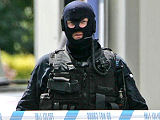
"oooh! the local bobbie looks like a terrorist!"
|
Two arrests at Liverpool Street station
29/07/2005 - 15:15:00
Armed police arrested two women at Liverpool Street station and evacuated the area, officers said today. The suspects were pinned to the ground in a dramatic swoop on the central London station, witnesses said.
One woman is thought to have been in a queue for the Stansted Express when she was pushed to the ground by police.
British Transport Police said the operation was carried out by Scotland Yard officers and confirmed that the site was being searched. Both the mainline station and the Underground station were evacuated.
Both Liverpool Street Underground and mainline stations were later reopened. "A number of packages were examined, but the stations have now been reopened," said a spokesman.
|
|
A BTP spokesman said: "The two women were arrested at around 1.54pm."
A witness told BBC News 24 that plainclothes police "suddenly burst into the main centre of the station and arrested two women.
"They pinned them down on the floor, put their hands behind their backs, put handcuffs on them and took them away," he said. "All the station staff arrived and started evacuating the station. They've now evacuated the whole of Liverpool Street station and some of the streets nearby. "There are now hundreds of people surrounding the station who were trying to catch a train and can't get in." He said: "One witness said one of the women was queuing at the Stansted Express ticket office and another said they saw a rucksack nearby on the floor, but I didn't see that."
He said he saw plainclothes officers "wearing caps which indicated they were police". "I was getting off one train, and probably about 20 yards away from one of the those women when she was arrested. "Initially there was obviously a bit of chaos. They tried to push people away and tried to stop people taking pictures with their mobile telephones. "They were gradually pushing people further and further back."
- IOL
|
|
|
Four bomb suspects now in custody
29/07/2005 - 18:23:12
Four suspected would-be suicide bombers have been rounded up by police hunting those responsible for the failed July 21 attacks in London.
The fourth man was held in Rome today, an Italian government minister confirmed. He was described as a Somali man called Osman Hussain who is a naturalised British citizen, Minister Giuseppe Pisanu said.
The Italian police operation is continuing.
|
|
Earlier, two men detectives strongly believe to be would-be suicide bombers were arrested in London. One of them was believed to be Muktar Said-Ibrahim, 27, who allegedly tried to blow himself up on a number 26 bus in Hackney, east London. The other is believed to have been responsible for an attempted bombing near Oval Tube station on the same day. A third man was also arrested as armed police launched two raids in west London this morning.
Police believe there were almost certainly five bombers on July 21. The fifth man is still on the run.
Reports from Italy said Hussain was 27-years-old and had a brother living in Rome. Italian police have been collaborating with Scotland Yard and British intelligence agencies.
In London one of the armed raids ended in a siege at a flat on an estate near Wormwood Scrubs Prison in west London. Until today, police had arrested only one of the bomb suspects. Yasin Hassan Omar, a 24-year-old Somalian alleged to have tried to set off a bomb on a train near Warren Street, was held during an operation in Birmingham on Wednesday morning.
Detectives believe there was also a fifth bomber because a fifth device was found in a rucksack dumped on open ground at Little Wormwood Scrubs, a few hundred yards from today's siege. It is believed the fifth bomber may have tried to detonate his device on a bus or train but no one noticed and he dumped it.
Today's siege took place at a block of flats owned by the Peabody Trust and involved elite plainclothes firearms officers and snipers from Scotland Yard's SO19 unit.
Nicolas Holliman, who lives on the 350-property estate, said he had seen four officers with guns and rifles and a specialist firearms officer in a gas mask.
They were focusing on a top-floor flat in one of the blocks on the estate and kept asking for "Mohammed" to come out. He was being asked to come out with his hands up, naked or in underclothes," he said.
Mr Holliman said he could tell there was more than one man in the flat by the way police were shouting and there were vocal protests coming from the flat.
After some time, Mr Holliman said he heard several shots which he believed were gas being fired at the flat and then there was silence.
She said the officers had been trying to reassure the man that he would be safe.
In the other raid less than a mile away, dozens of officers, some wearing gas masks, swooped on the Tavistock Crescent area of Notting Hill, clearing a wide area and cordoning off streets. Snipers were stationed behind parked cars.
|
|
During the day there were reports of explosions and gunshots from residents near the raids. But the explosion is thought to have been police blowing the door off a flat and the "shots" were stun grenades or CS gas.
Armed police also arrested two women at Liverpool Street station in the City of London. The suspects were pinned to the ground just before 2pm, witnesses said.
The operation was carried out by Scotland Yard officers. Both the mainline station and the Underground station were evacuated while police looked at a number of suspect packages.
Witnesses said the two women were in Muslim dress. They were arrested close to the Stansted Express ticket office and handcuffed on the ground. - IOL
|
|
|
Brother held in Notting Hill raid
By Marco Giannangeli and Richard Alleyne (Filed: 30/07/2005)
A man arrested yesterday in a raid in the upmarket West London area of Notting Hill was named as Wahbi Mohammed, 22, the brother of Ramzi Mohammed, who was arrested in Delgano Gardens.
Residents said about a dozen police, armed with machine guns and wearing gas masks, sealed off streets near to the fashionable Portobello Road before storming two flats at about 11am.
A number of explosions then rang out around the area, thought to be police blowing the door off a flat and using stun grenades or tear gas.
More than 100 householders were ordered to evacuate surrounding homes as bomb disposal units moved in, a police helicopter hovered overhead and police marksmen took up positions.
Witnesses said a man was wrestled to the ground and led away from a residence in Tavistock Crescent.
Louise Thompson, 22, a student who lives in the road, said: "I saw policemen all around my flat and heard a few shots. "I'm not quite sure what it was but there were a couple of loud bangs. "I just looked out the window and saw about four uniformed police running round the back of my flat."
Zibi Gondect said about eight police officers surrounded a man wearing a white T-shirt and wrestled him to the ground. Moments later he was led away in handcuffs.
Kieran Batten, 32, a civil engineer from Hitchin, Herts, said he and colleagues were working in a hole in the street when they were told to leave the area by armed police.
"We were digging a hole in the road when we saw armed police come running past," Mr Batten said. "The police shouted, 'Get out of the hole and get out of the area'. "I carried on working really because somebody's house would have been flooded if we had stopped. "We could see the police running past and they stationed themselves around the park, close to a block of flats. They took positions and seemed to be targeting a particular flat just above a doorway. "We could see a white curtain moving but we were too far away to make out who was in the building."
One neighbour said she had been panicked by the sound of explosions and loud bangs at about 11am.
Davina Johnson said: "Suddenly, we heard five or six bangs. It could have been shooting but it was followed by a louder bang. "We were all very frightened and we didn't know what to do. Then I saw police begin to cordon off the roads."
Tavistock Road runs close to Westbourne Park Underground station, where the man who attempted to blow himself up on a train near Shepherd's Bush on July 21 got on to the Tube network.
Janice Dyson, 46, a housewife, said: "I have lived here for 22 years and have never seen anything like this before.
"It is unreal, like you are watching it happening elsewhere."
- Telegraph |
News Blackout
|
News blackout shields London police
July 30, 2005 - 3:30PM - As armed police closed in on a London apartment block, television helicopters roared overhead with cameras rolling and reporters and crews in satellite broadcast trucks stood witness at the scene.
But those who tuned into coverage of the hunt for the London bombers yesterday were left in the dark by an hour-long news blackout requested by police to help secure the operation.
It was an unusual interruption in news coverage in which dramatic arrest raids and press conferences have unfolded live before TV audiences. Fast-paced developments have been broadcast around the clock since a squad of four suicide bombers struck on London Underground trains and a bus on July 7, killing 56 people. A second series of strikes two weeks later, in which bombs carried onto the city's transport network failed to properly detonate, only increased the intensity of the coverage.
But as police launched a major operation yesterday - sending in officers armed with assault rifles to flush out suspects from homes in west London's Notting Hill neighbourhood - the television stations stopped feeding live from the scene.
The reason - a request from the Metropolitan Police for media to back off so as not to give away details of their next sweep.
Media organisations were told that lives could be put at risk if they broadcast live footage or ran commentaries as raids unfolded in the quiet neighbourhood. The stations abided.
"Following discussions with Scotland Yard, Sky News voluntarily imposed a news blackout of certain elements of the siege," a Sky spokesman said in a prepared statement. "This is standard practice to assist with some police procedures but any decision remains an editorial one," the spokesman said.
Nick Wrenn, managing editor of CNN Europe, Middle East and Africa, said his newsroom was investigating events in Notting Hill when they received word of the police request. The network decided to hold off on reporting the developments live. "We agreed it was a reasonable request from Scotland Yard because of the reasons they outlined and we decided we would review it constantly as the story developed," Wrenn said.
"We were getting our satellite truck in place, we were getting our reporters and crews mobilised and we've been in breaking news mode ever since because the story has moved so quickly," Wrenn said.
A BBC spokeswoman said while the newsgathering process continued as normal, nothing went to air until police gave their OK about an hour later.
"We were interviewing witnesses and filming with our helicopter. We just didn't broadcast anything until the blackout was lifted," the spokeswoman said.
Members of the public have joined in as well, becoming amateur news gatherers by phoning in eyewitness accounts to TV stations and emailing pictures and video captured on their mobile phones.
Police recently asked British broadcasters to stop using mobile phone images sent in by the public. But so far, it doesn't appear that media organisations eager to feed the demand have stopped putting them out.
Wrenn and the BBC spokeswoman said requests for a media blackout were issued occasionally by police during sensitive investigations.
Broadcasters don't always comply and are not obliged to, but on this occasion they agreed it was best to halt live coverage.
"I think if police tell us that there are situations where licence-to-shoot operations could be implemented, then that is obviously a request we are going to take seriously," Wrenn said.
CNN had cameras poised on one of the homes targeted in the police operation, but when asked to move back for safety reasons they agreed to do so, Wrenn said.
"It's not our policy to go bursting through police cordons when there is an armed operation going on," he said.
AP via SMH
unverified press release issues guidelines on Menezes reporting
|
|
Bomb suspect at Rome hearing
Published: 30 Jul 2005 By: Channel 4 News
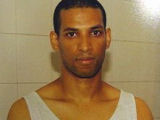
The focus of the investigation in Italy overnight is an apartment in Rome where Hussain Osman - believed to one of the four suspects in the attempted bombing in London - had been hiding. He was tracked down by a trace on his mobile phone calls -and arrested by Italian police yesterday it's reported at his brother's flat.
Born in Ethiopia, is it thought he used the name Hussain as an alias when he posed as a Somali refugee and was given British residency. His partner and two children live in South London. Hussain Osman fled to Europe on a Eurostar train - said Italy's Interior Minister.
|
|
Giuseppe Pisanu, Italian Interior Minister, said: "After the attack, on the basis of this investigation, it became possible to document the various steps of the flight of Osman Hussain from Great Britain - when he left London, from Waterloo station."
That train journey was four days after Osman's photo had been released by the police, five days after the attempted bombing and a national manhunt was well underway, with all ports supposedly on alert.
Eurostar said today it isn't the company's responsibility to vet who goes on their trains.
However Channel 4 news has learned that on that day at Waterloo there were stringent passport checks being carried out by the police and security services.
This evening proceedings began to extradite Osman to the UK. At least 15 properties are being searched by Italian police - they're looking into whether Osman was helped by contacts in the Eritrean and Ethiopian communities. - Channel 4 news UK
|
|
Fourth would-be bomber located in Italy
29/07/2005 - 17:28:04
The fourth would-be London bomber has been arrested in Rome, according to Italian interior minister Giuseppe Pisanu.
Mr Pisanu was quoted on the Italian news agency Ansa as sending his congratulations to police in the city.
The alleged bomber was named as a Somali, Osman Hussain, and is thought to have attempted to set off an explosion at Shepherd's Bush.
- IOL
|
Police arrest fifth London bomb suspect
29/07/2005 - 23:08:58 - All the alleged July 21 suicide bombers were in custody tonight after a stunning coup by anti-terrorist police. After eight days on the run the gang were rounded up in a series of dramatic raids. Two of them refused to come out of a flat in west London when police swooped and, following a siege, CS gas was fired into the building.
The two were Muktar Said-Ibrahim, 27, a naturalised Briton from Eritrea who is the alleged Hackney bus bomber, and a man who gave his name as Ramzi Mohammed. He is accused of trying to blow up a train near Oval Tube station.
A third suspect Hussain Osman, 27, a naturalised British Somali, was held in Rome.
Police believe he may be the man who tried to detonate his device on a train near Shepherd's Bush. He has been held under a European arrest warrant and Britain will seek to extradite him.
IOL
|
just a coincidence...er...Osman Hussain / Hussain Osman
Saddam Hussein
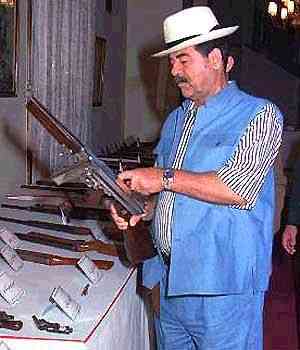
|
|
|
|
Ethiopian-born Osman Hussain, 27, was arrested in Rome and is suspected of trying to bomb a Hammersmith and City Line train at Shepherd's Bush.
Hussain, a British citizen, has also been named as Isaac Hamdi.
|
|
Ramzi Mohammed
aren't this guys trousers a little dark?
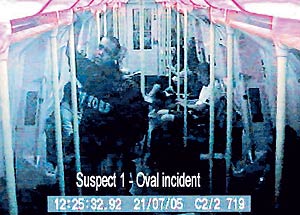
Same guy?
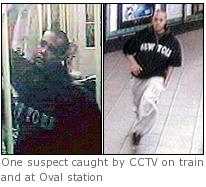
They are cropped out on this photo
|
Ramzi Mohammed
Ramzi Mohammed, is suspected of attempting to bomb the Tube near Oval station. Few details are known about him and his name had not been released prior to his arrest.
has he got the same darkness of skin...or shape of face?
|
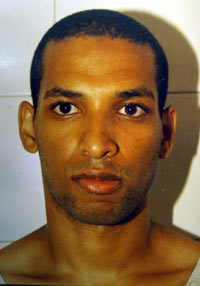
Yasin Hussan Omar
How digitised is this photo...why blow it up to this size?
|
Man Admits Role in Failed London Attack
By FRANCES D'EMILIO, Associated Press Writer - Saturday, July 30, 2005 ROME, Italy (AP) --
A suspect in the failed London transit bombings admitted Saturday to a role in the attack but said it was only intended to be an attention-grabbing strike, not a deadly one, a legal expert familiar with the investigation said. Osman Hussain told interrogators he wasn't carrying enough explosives even to "harm people nearby," the expert told The Associated Press. The expert spoke on condition of anonymity, citing the ongoing investigation, which under Italian law must remain secret. Hussain, 27, one of four suspected bombers in the July 21 attacks, is suspected of trying to bomb the Shepherd's Bush subway station in west London, two weeks after the four deadly attacks on the city's transit system that killed 56 people, including the four suicide bombers.
Hussain was arrested Friday in Rome at his brother's apartment after police traced calls he made from a cell phone as he traveled across Europe. Hussain was calm and coherent at a hearing in a Rome prison Saturday, but doesn't consider himself a terrorist and may be gearing up to fight his extradition to Britain, his court-court appointed lawyer, Antonietta Sonnessa, said.
Grilled by a pair of Italy's top anti-terrorism prosecutors, Hussain said that months ago in London, his chief — who he identified as "Muktar" — taught him how to assemble explosives using fertilizers and stuff explosives and timers into backpacks, the Rome daily La Repubblica said.
Hussain was referring to Muktar Said Ibrahim, 27, one of the other bombing suspects captured Friday in a London raid, the newspaper said. Ibrahim is suspected of planting explosives on a London bus on July 21.
"Muktar urged us to be careful" La Repubblica quoted Hussain as telling his interrogators. "We didn't want to kill, just sow terror."
He also reportedly told investigators the bombers were motivated by anger over the U.S.-led war in Iraq.
Hussain also said his cell was not linked to either al-Qaida or the cell that carried out deadly bombings July 7, Italian media reported.
The lawyer described her client as "calm enough" during an initial extradition hearing at Rome's Regina Coeli prison and told AP he "probably would prefer to stay in Italy," suggesting he would fight Britain's bid to extradite him. Opposing extradition could delay a decision on extradition, a process which can take weeks or months.
Sonnessa said no formal charges were lodged but "certain things are being said, certain accusations are being raised." "He doesn't consider himself a terrorist," Sonnessa told Italian TV. Asked about what line he took when interrogated, she declined to be specific, but said: "He defended himself with extreme calm, coherence."
Interior Minister Giuseppe Pisanu, briefing lawmakers, said Hussain counted on an extensive network from the Horn of Africa in Italy to protect him in his flight from London, through Paris and to Rome. "During the investigation, it has been possible to pinpoint an extensive network of subjects from the Eritrean and Ethiopian communities in Italy considered to have played a role in covering for the fugitive," the minister said.
Top anti-terrorism investigators have said for years that Italy is a logistics base for international terrorists, including in providing false documents to help travel. Police in Milan, while hunting down suspected accomplices in Hussain's flight, raided a center which was producing false documents, Pisanu said. Investigators were studying the seized material. Police fanned out across Italy on the trail of Hussain's contacts Saturday. More than a dozen searches were launched in cities from north to south, including Venice and the port city Salerno, Pisanu said.
Pisanu said Hussain's flight from London began on Tuesday, July 26, at Waterloo Station, the main London terminal for Eurostar that carries passengers from Britain to mainland Europe via the Channel Tunnel. A cell phone apparently used by Hussain was active in Paris on Wednesday, then its signal disappeared, Corriere della Sera reported. The signal next appeared on Thursday in the vicinity of Milan's train station, it said. "We are facing a grave threat which must be dealt with all means of prevention and crackdown that we have," Pisanu told the Chamber of Deputies shortly before it approved a government decree tightening anti-terrorism measures.
Investigators were checking out what Hussain intended to do while in Italy. Corriere said he told his interrogators he had no intentions of carrying out attacks, and investigators said nothing discovered so far indicated otherwise, the paper said. Newspapers said Hussain's real name was Hamdi Isaac. His brother, who was also reported arrested Friday after guiding police to Hussain's hideout in Rome, was identified in news accounts as Remzi Isaac.
- sfgate.com
|
French arrogant?
| Who 'let' Osman get away?...
Concerns are being raised as to how Osman was able to leave the country amid a massive manhunt. After the July 7 attacks and the attempted bombings a fortnight later, the police elite Special Branch unit was supposed to be monitoring the Eurostar terminal. British immigration officials were also making spot checks on certain passengers. Yesterday the Home Office refused to comment on security lapses or to reveal what information had been given to French officials at Waterloo. Officials are understood to be urgently retrieving Osman's immigration records but Charles Clarke, the home secretary, is on a long vacation in New England and therefore unable oversee inquiries into the alleged failings of the immigration service.
A senior police source said that the Eurostar terminal was "plastered" with pictures of the men. He alleged that French and British immigration officials were to blame for letting Osman slip through. "This shows the controls were fairly weak," he said. "This man's photograph, like that of all the suspects, was plastered all over Waterloo station, including at the Eurostar terminal.
"The French officials there can be a little difficult at times. It's just their attitude. It's the French way, slightly arrogant."
A police spokesman said the CCTV image of the Shepherd's Bush bomb suspect, whose identity was not known when he left the country, was the least clear of the four. A better image was released only last Thursday, after he had left the country.
The suspected bomber's successful escape will lead to renewed calls for a tightening of security controls at Britain's borders. - Times
|
| Flashback: Jul 11 - French annoy Clarke [he he!]
London bombs suggest local but well-equipped cell
Jul 11, 2005 - By Mark Trevelyan and Mike Holden
LONDON (Reuters) - Suspected al Qaeda militants behind the London bombings may well have come from a previously unknown local cell and yet had access to military explosives, European security officials familiar with the probe said.
"The explosives appear to be of military origin, which is very worrying," said Christophe Chaboud, head of the French Anti-Terrorism Coordination Unit and one of five top officials sent by Paris to London immediately after Thursday's attacks.
"We're more used to cells making home-made explosives with chemicals. How did they get them?" he said in an interview with Le Monde newspaper.
"Either by trafficking, for example, in the Balkans, or they had someone on the inside who enabled them to get them out of a military establishment."
Chaboud's comments went further than London police, who have only said so far that the bombs contained less than 10 lb. (4.5 kg) each of "high explosives" and were small enough to be carried in rucksacks.
By comparison, the 10 bombs that blew apart four commuter trains in Madrid last year weighed about 22 lb. (10 kg) each. The explosive, known as Goma 2 Eco and used in quarrying, had been stolen from a mine in northern Spain. Asked about the French comments, a senior London police spokesman said the explosives were still being examined and there was no confirmation that they were military in origin. - Reuters
|
|
After bombing, a deepening French-British rift
By Elaine Sciolino The New York Times SUNDAY, JULY 17, 2005
LONDON: Britain's era of good will with Europe lasted 48 hours - all because of the French.
In the wake of the July 7 terrorist attacks in London, Scotland Yard brought together law enforcement and intelligence officials from two dozen European countries and the United States, sharing crucial intelligence and pleading for help in tracking down the bombers.
But the continentwide spirit of cooperation was shattered when Christophe Chaboud, France's new antiterrorism coordinator, broke the cardinal rule of the club. He leaked.
In an interview with the French newspaper Le Monde that appeared on newsstands on July 11 two days after the exceptionally open briefing - Chaboud announced that he knew ''the nature of the explosives'' used in the London bombings.
It ''appears to be military, which is very worrisome,'' he said, adding: ''We're more used to cells making homemade explosives from chemical substances.''
But Chaboud did not stop with his assessment of the explosives and their origins, which, it turned out, were completely wrong. He plunged into politics, saying Europe was a more dangerous place because of the war in Iraq. ''The wa in Iraq has revived the logic of total conflict against the West,'' he declared, without adding the obvious, that Britain supported the war and France did not.
The British reacted with fury, sending off communiques to a number of its European friends that expressed deep disappointment that the bonds of trust had been broken, according to two European officials who received the missives.
So poisonous is the atmosphere that the talk in European intelligence circles is that the British feel that the French may have leaked bad information on purpose.
''They believe they released this incorrect information deliberately,'' said the head of a European intelligence agency. The result, he added, is ''there's not much good will left between them.''
While that may be going much too far, it is clear that the French-British rivalry is exceptionally intense these days. First, there was the verbal battle between the French president, Jacques Chirac, and the British prime minister, Tony Blair, in Brussels last month, when each accused the other of greed and responsibility for the failure of the European Union budget meeting.
Then came jokes by Chirac (overheard by a reporter for the French daily Liberation) to the German chancellor, Gerhard Schröder, and the Russian president, Vladimir Putin, in Kaliningrad this month: ''The only thing'' that Britain ''has done for European agriculture is mad cow,'' Chirac was quoted as saying.
That was topped by London's victory over Paris in the competition to serve as the host for the 2012 Olympics, a decision that prompted Paris's mayor, Bertrand Delanoë, to essentially accuse the British of bribery.
Intelligence-sharing between Britain and France has traditionally transcended politics. Eliza Manningham-Buller, the director general of MI5, Britain's domestic intelligence agency, was in Paris days before the bombings on a visit to exchange ideas with her French counterpart, Pierre de Bousquet. And senior officials at France's Directorate-General of External Security, the equivalent of the CIA, routinely praise their close working relationship with Britain.
Still, these are not normal times. After an emergency EU summit meeting of justice and interior ministers in Brussels on July 13, the French interior minister, Nicolas Sarkozy, suggested that part of the cell responsible for the London terror attacks had been arrested before.
The remarks prompted an immediate response from the British home secretary, Charles Clarke, who had called the meeting. ''I've heard Sarkozy's remarks to the press and there is absolutely no foundation in them,'' Clarke said in a news conference.
Asked whether he had confronted Sarkozy directly about his statements, Clarke said there had not been the opportunity because Sarkozy left the meeting ''halfway through.''
''He didn't feel it was appropriate to stay to the end of the discussions,'' Clarke said. Meanwhile, the investigation into the London bombings continues, with British police and intelligence officials handling the information they share with their European counterparts with extreme care. ''This leak by the French has been very badly perceived,'' said a senior intelligence official in one European police force. ''Since then, it's no longer worth it to try to get information from the British.'' -
The New York Times
"My friends in London are furious at the French about this," said the director of a European intelligence agency. "They believe they released this incorrect information deliberately." The result, he added, is "there's not much good will left between them." - No Pasaran
|
|
|
Why would French Intelligence 'Leak' such information?
Were military explosives used...?
Isn't it handy that the Fleeing of Osman will enable the strengthening of Border controls, no doubt with lots of Biometric securitech goodies
I think we've been played...by a theatre of UK/French collusion
|
[Special Branch on Border Patrol??? MI5 to get more funding: what a suprise!]
from a Time report - July 17, 2005
Nonetheless, critics say the case highlights the "porous" nature of Britain's borders. David Davis, the shadow home secretary, said he had been told there were only 900 Special Branch officers guarding Britain's ports, 500 short of the official complement. This claim has been verified by senior police officers. Mark Oaten, the Liberal Democrat home affairs spokesman, said reports of the alleged mastermind's trip to Britain threw up questions about a lack of police and intelligence resources. He said he would raise the issue with Charles Clarke, the home secretary.
MI5 will use its increased funding to open eight regional offices this year, including one in the northwest that will cover Leeds and Dewsbury, where three of the bombers lived. It will increase its manpower by 50% to 3,000 officers by 2008. An official said it took a long time to recruit and train intelligence officers. It was too early to tell if ministers would promise to add extra money to the pre-existing spending plans.
- timesonline.co.uk
|
|
|
Bombing Suspect Used Fake Name to Enter UK
By AIDAN LEWIS Associated Press Writer
ROME (AP) -- Italian authorities said Monday that a London bombing suspect arrested in Rome had falsified his name and nationality to enter Britain, adding that they expected the extradition of the man to Britain would not take long. Ethiopian-born Hamdi Issac changed his name to Osman Hussain and said he was a Somali when he arrived in London to make his request for political asylum, Carlo De Stefano, the head of Rome's anti-terror police, said in the first police briefing since the suspect's arrest in the Italian capital last week.
"He changed his name to Osman Hussain when he arrived in London, he falsely declared he was a Somali citizen, to obtain the status of political refugee and economic assistance more easily," he said.
Issac is being kept in a Rome prison and is awaiting possible extradition.
"I believe that it won't take long," De Stefano told reporters at the Interior Ministry.
Also arrested were Issac's two brothers: Remzi Issac was hiding the suspect in his apartment; and Fati Issac, picked up Sunday in the northern industrial city of Brescia and accused of destroying or hiding documents sought by investigators.
De Stefano said that people who have been supporting the suspect in his escape from London, including his brothers, were not being linked to any terror activities or investigation in Italy. They only had family ties or were friends with the suspect. - NY Post
|
|
Seven more held after police raids in Brighton
By Terry Kirby and Nigel Morris- 01 August 2005
Seven people were arrested yesterday as the extensive investigation into the London bombing attacks of 21 July moved rapidly in Britain and Italy.
The latest arrests were in Brighton. Police in Rome, aided by British investigators, have detained a brother of Osman Hussain, the fourth suspect. And ministers are considering tougher passport checks on travellers leaving the country amid embarrassment that Hussain, suspected of being the Shepherd's Bush station bomber, slipped undetected out of Britain on a Eurostar train as his picture was displayed around Waterloo station.
Police said the high-profile arrests did not mean the inquiry was being wound down or that the threat had diminished. Deputy Assistant Commissioner Peter Clarke, the head of the Anti-Terrorist Branch, said the threat remained very real and urged people to remain vigilant. Detectives are still looking for others involved in the organising of both the 7 and 21 July attacks and are aware that more terror cells could exist.
A spokeswoman said: "We are searching for other people. We are not talking about cells. We have never spoken about a third cell. There were other people involved in the incidents of the 7th and the 21st. It's extremely likely there will be other people involved in harbouring, financing and making the devices."
Scotland Yard said the latest raids were on two addresses in Brighton where six men and a woman were arrested. The Yard said armed officers were not involved and those arrested were being interviewed at police stations in the Sussex area. A total of 20 people are now in custody and properties are still being searched.
Police said they would not be providing a "running commentary" on the questioning of Muktar Said Ibrahim, 27, accused of the failed Hackney bus bombing, Ramzi Mohammed, suspected of attempting the Oval Tube bombing, and his brother, Wahbi Mohammed, suspected of being a "fifth" bomber, all captured in raids in west London on Friday.
They are being held at Paddington Green police station in west London with Yasin Hassan Omar, 24, suspected of attempting to blow up a Tube train at Warren Street station. He was arrested in Birmingham. Under anti-terrorism legislation they have 14 days to interview them.
In Rome, Osman Hussain was reported by Italian newspapers to have told an investigating judge that the 21 July attacks were motivated by anger over Iraq, rather than religious reasons. He is also reported to have said the attacks were designed as a copycat of the 7 July bombings and aimed at frightening people.
He is said to have claimed he was not carrying enough explosives even to "harm people nearby". He is being held at Rome's high-security Regina Coeli prison. Two of his brothers have also been arrested by Italian police, one on Friday, and a second yesterday in Brescia, in the north.
Hussain is said to be prepared to fight extradition, which would be the first under the new fast-track procedure for terrorist suspects. He left Britain by Eurostar on Tuesday last week, the day before police released a clear image of him on a bus heading towards south London and simultaneously raided a house in Stockwell where it was believed he lived. Three women there were arrested. The suspect was traced to France using mobile telephone intercepts, then tracked to Rome, where his brother ran an internet café.
Home Office officials were unable to say why Hussain was not apprehended despite precautions introduced after the 7 July attacks. Embarkation checks were scrapped in 1994 for travellers to the European Union and four years later for other countries. But they were reinstated for 10 days after the 7 July blasts and again after the failed 21 July attacks. They will remain for the foreseeable future.
Geoff Hoon, the Leader of the Commons, was asked yesterday about passport checks at Waterloo station. He said: "I understand that concern, and I am aware that the Home Office will be looking at that. Certainly in recent times there has been enhanced security for those leaving the country, as well as for those coming into the UK. It is something we must continue to look at very carefully."
The Home Office is developing an "e-borders" scheme, under which the records of passengers, both those heading for and those leaving Britain, are checked against international lists of terrorist suspects. Two of the three women held on Wednesday in Stockwell remain in police hands and the third has been released on police bail until early September.
Also in custody in London are a man arrested in Stockwell on Friday, 22 July, and two men held in New Southgate on 24 and 25 July. Police also arrested another man in Finchley, north London, on Tuesday. They have been granted permission to question these men until 2 August.
A man held in Tulse Hill, south London, on 23 July was released without charge at the weekend as were two women held on Friday at Liverpool Street station in the City of London. - Belfast Telegraph
|
|
Police arrest two men in London bomb probe raids
01 Aug 2005 21:20:10 GMT- Source: Reuters (Adds arrest footage, paras 3-5, lawyer's interview paras 12-13)
LONDON, Aug 1 (Reuters) - British police arrested two men under anti-terrorism laws in south London on Monday in raids linked to the July 21 attempts to bomb the capital, a police spokesman said.
The men were arrested during police searches of properties in the Clapham area and nearby Stockwell, where police shot dead a Brazilian man they mistook for a suspected suicide bomber on July 22.
Amateur video footage broadcast on the BBC showed armed police wearing black masks surrounding a man pinned against the front of a red-brick house in Stockwell.
Police wearing blue-hooded overalls dressed the suspect in an all-in-one suit, which is designed to preserve any forensic evidence.
"They were arrested on suspicion of the commission, preparation or instigation of acts of terrorism," the spokesman said. "They are in custody at a central London police station."
No more details of those arrested were released.
Detectives are questioning 18 others held as part of the probe into the July 21 attacks, the biggest operation for London's police since World War Two.
Suicide bombers killed 52 people in attacks on three underground trains and a bus in central London on July 7. Two weeks later, a gang left four more bombs on the transport system, but the devices failed to go off.
Police say they have arrested the four men they believe were behind the July 21 attacks. One suspect was held in Italy on Friday.
Italian police said Hamdi Issac -- also known as Osman Hussein - fled to family and friends in Italy, instead of criminals, after the failed second wave of bombings in London. They said he was more likely part of a rag-tag group of amateurs than a broad Islamic militant network.
His Italian lawyer has repeatedly suggested Hamdi will resist extradition. - Reuters
|
|
|
Italian Police Traced Phone Calls to London Bomb Suspect
By Michael Drudge [!!!] London 01 August 2005
Italian police say they were able to track down a suspect in last month's attempted terrorist bombings in London because the man made several calls from his cell phone after fleeing Britain.
The chief of Italy's anti-terrorist police, Carlo de Stefano, has given the first detailed account of how Italian police captured one of the four prime suspects in the bungled bombings of London's transport network on July 21. Mr. De Stefano says the suspect, known as both Hamdi Issac and Osman Hussein, made several calls from his cellular telephone after he fled London by train on July 23. He traveled first through Paris and then northern Italy before arriving at the home of a brother living in Rome. Mr. De Stefano says London police provided a key clue that led to the arrest.
"His identification was further confirmed due to a small wound he had on his right foot," he said. "This information was given to us by the Metropolitan Police in Britain. This wound was sustained as he tried to escape from the scene in London."
Police experts are expressing astonishment that someone under such an intense manhunt would make traceable phone calls, as former Scotland Yard commander John O'Conner explained on British television.
"This just shows how basically amateurish this particular terrorist was," he explained. "I mean you don't expect any of the hard terrorists to be using mobile phones like that, or certainly mobile phones that can come back to them."
|
|
Italian authorities say they are virtually certain that Hamdi Issac is not connected to a larger terrorist conspiracy, a finding that could speed up his extradition to Britain.
London police continue to question three other prime suspects in the July 21 incidents, in which bombs that failed to fully detonate were placed on three subway trains and a bus.
There are concerns other undetected terrorist cells could be plotting new attacks.
A terrorism analyst at London's Center for Defense and International Security Studies, Mark Baillie, compares the extent of Britain's Islamic terrorist network with that of the Irish Republican Army.
"There are definitely other cells active in Britain," said Mr. Baillie.
"The amount of activists and sympathizers for the jihadi extremists in the United Kingdom is at least as high as it was for the IRA's 30-year-long campaign. A few hundred activists and 10, 12, 16,000 supporters. That's quite enough."
Meanwhile, London police maintain the high alert that began on July 7 when a team of four British Muslim suicide bombers blew up themselves and 52 passengers on London's transport system.
VOA
|
Britons held in Dubai in London bombs probe
03/08/2005 - 08:38:02 - Three British men were arrested in Dubai and held for 10 days before being released without charge, Britain's Foreign Office said today. The trio were reportedly detained in connection with the London bomb attacks on July 7. It is thought they arrived back in Britain on Monday.
A Foreign Office spokesman said: "Three British nationals were detained by the Dubai authorities on July 21. "All three were released on July 30 without charge. They were given full consular contact to ensure all their needs were met."
The FO spokesman said he had received no reports of them being poorly treated.
But two of the men, Mohammed Rafiq Siddique and Alam Ghafoor, claimed they were threatened and deprived of sleep.
Businessman Mr Ghafoor told the Guardian newspaper: "One guy said 'You will never get out, we can hold you for 10 years, no-one will ever find you, your Government will do nothing.'
"One said 'We'll kill you and feed you to the dogs and there will be no trace of you."'
Mr Ghafoor, 34, reportedly said that over the course of four days he was denied sleep and was made to write a false confession, saying he knew the bombers. The Briton also apparently claimed he was detained after British intelligence tipped off the Dubai authorities.
His colleague, 38-year-old Mr Siddique, told the paper: "I want some answers from the British Government. Did the intelligence services tip them off to arrest us?
"The British government could have acted a lot quicker and faster."
Scotland Yard said they were not aware of any British nationals being arrested in Dubai in relation to their investigation into the attacks on London. - IOL
|
Women in court over 21 July bombs
Friday, 5 August 2005 - Two London sisters are due in court after being charged with failing to disclose information in the wake of the 21 July attempted bombings. Yeshshiembet Girma, 28, and Muluemebet Girma, 21, of Stockwell, will appear at Bow Street Magistrates Court on Friday.
The only other person charged over the attacks, Ismael Abdurahman, 23, of Kennington, south London, was remanded in custody at Bow Street on Thursday. He is accused of failing to disclose information about a suspected bomber.
The sisters, of separate addresses, are accused of "having information that they knew or believed might be of material assistance in securing the apprehension, prosecution or conviction of another person in the UK for an offence involving the commission, preparation or instigation of an act of terrorism". The charges, under section 38 of the Terrorism Act, add that they "failed to disclose that information as soon as reasonably practicable to a constable" between 21 July and 28 July.
Mr Abdurahman faces the same charge in relation to the Shepherd's Bush attempted bombing. In a brief hearing lasting just under 10 minutes, Mr Abdurahman spoke only to give his name.
District judge Timothy Workman remanded him in custody until 11 August.
Police are holding a total of 15 people over the failed attacks.
BBC
|
More asylum - Benefits / terrorist - zenophobic linking
|
Bank of England freezes accounts of London bomb suspects
London, Aug. 6 (PTI): The Bank of England has frozen the financial accounts belonging to the four suspected July 21 London bombers as Scotland Yard investigates allegations that the men collected more than 500,000 pounds in benefit payments in Britain.
The Bank of England listed the men's various names and personal details on its website accompanied by a statement which said the "Bank of England, agent for her Majesty's Treasury, has today directed that any funds held for or on behalf of individuals named must be frozen, and that no funds or financial should be made available, directly or indirectly to any person, except under the authority of a licence."
Bank officials disclosed the financial details of the suspects, Ramzi Mohammad, Yasin Hassan Omar, Muktar Said-Ibrahim and Hussain Osman, which showed how the men, all in custody, have used multiple aliases and addresses in recent years.
Ibrahim is said to have had six aliases. Some are also shown to have claimed several nationalities, ages and national insurance numbers while in Britain.
Investigators believe that bogus names were used to make some benefit claims. Scotland Yard was investigating allegations that the men collected more than 500,000 pounds in benefit payments in Britain. Two are also alleged to have obtained asylum using bogus passports and false names and nationalities, the police said. All the addresses registered to the suspects were in Greater London, and each man is known to have had at least one national insurance number.
23-year-old Mohammed, who has been linked to the Oval Tube attack, is said to have used six addresses in southwest and West London. One is said to be on the Peabody Estate, in North Kensington, where he surrendered to police with Ibrahim last Friday. Ibrahim, alleged to be the Hackney bus bomber is believed to have used two dates of birth, six aliases, two national insurance numbers and two addresses - both in the Stoke Newington area of North London.
27-year-old Osman, now fighting extradition from Italy and accused of being the Shepherds Bush attacker, apparently went under five names, variously claimed that he was Eritrean or Somali, and used four addresses in southwest London. Omar, 24, who is linked with the attack on a Tube train near Warren Street, had five aliases and lived in New Southgate. Meanwhile, police across Europe are investigating whether any of the suspects or their families are linked to finance networks used by terror groups.
Channel 4 News said last night Osman was one of a group extremists reported to police in 2003 for causing trouble at a mosque in Stockwell, south London. The mosque trustees wrote to police saying the group had "an agenda to turn this centre into another Finsbury Park mosque... problems have now reached a level where police help is urgently needed."
Radical clerics advocated holy war in Finsbury Park mosque. Toaha Qureshi, a trustee, told the programme that police took no action at the time.
- hindu.com
|
|
|
My Tube bomb only had flour in it, says suspect
By Bruce Johnston in Rome and John Steele (Filed: 04/08/2005)
Hamdi Issac, the July 21 London bomb suspect held in custody in Rome, reportedly claimed yesterday that his backpack contained only flour and was designed merely to frighten. Issac, known in Britain as Hussain Osman, was said to have "morally repented" for his alleged involvement in the abortive terrorist attacks.
"I was wrong," Issac, 27, a Briton of Ethiopian origin, told his lawyer, Maria Antonietta Sonnessa. She has confirmed that he admitted taking part in the attacks. The suspect in the failed Shepherd's Bush Underground bombing was also quoted as saying: "If I could, I'd turn the clock back and I wouldn't do it again." According to Italian newspapers, he claimed not to have planned to kill anybody in the attack, "let alone myself". "I value life too highly," he said. "I've never thought of dying. Just the thought of it terrifies me. It was a demonstrative action. In that backpack there was a detonator, but the rest was flour. It was only supposed to go bang, and frighten people."
His claims came as a 23-year-old man, believed to be an associate of Issac, last night became the first person to be charged in connection with either the July 7 or the July 21 attacks on the London transport system. Ismael Abdurahman, of Newport Street, Kennington, south London, will appear in court today charged with withholding information about Issac, one of four alleged would-be suicide bombers on July 21.
|
|
In Rome, a judge who has the British extradition request for Issac indicated yesterday that there could be a decision this month. Crown prosecutors issued a European arrest warrant after Issac was arrested at his brother Remzi's home in Rome last Friday.
"Tomorrow or the day after, a date for the hearing will be fixed," said Judge Domenico Massimo Miceli. "I believe that the debate could unfold by the end of August."
Miss Sonnessa rejected as "offensive" suggestions that she was seeking a deal with authorities to give her client "supergrass" status in return for his co-operation. The British embassy in Rome denied suggestions that the Crown Prosecution Service and Metropolitan Police were unhappy with co-operation from the Italians. Many claims being reported were incorrect, a spokesman said.
Scotland Yard did not despatch a number of officers within 24 hours of the arrest in Italy; one senior investigating officer was following the proceedings and liaising with the Italians. All requests made by the prosecuting authorities had been dealt with promptly by the Italians, and documentation provided by the British was full and complete.
The Italian authorities had requested clarification on an administrative aspect. "This has not delayed extradition proceedings," said the spokesman.
The Italian authorities had arrested Osman and his arrest had been validated by a judge, but this did not amount to a formal charge.
- Telegraph
London bomb suspect tells British police his device wouldn't have killed anyone
|
|
London bomb suspect 'was reported to the police two years ago'
London Independent | Aug 06 2005 - Police were warned that Osman Hussain, the bombing suspect arrested in Rome, was a dangerous extremist at least two years before the attempted attacks on London, it was claimed last night. Hussain, who is wanted for questioning in connection with the failed attack on Shepherd's Bush station, is said to have been brought to the attention of the Metropolitan Police by the trustees of Stockwell Mosque, in south London.
The trustees allege the 27-year-old Ethiopian was among a group who were trying to take over the management of the mosque by convincing attendees that it was not being run in accordance with Islamic law, Channel 4 News reported.
The news came as Hussain's lawyer was reported as saying that detectives from Scotland Yard are to fly to Rome to interrogate the suspect over his role in the July 21 bombings, ahead of his extradition hearing, due to be held on 17 August. They claim they wrote to the deputy commander of the local borough in July 2003, accusing Mr Osman and others of inciting racial hatred, supporting extremist views and harassing management at the mosque.
The trustees claim they wrote that the men were trying to "turn this centre into another Finsbury Park," and attached a diary of their complaints, in which police were said to have been called to the mosque because of the behaviour of Hussain.
Concerns were heightened when extremist Islamic graffiti was found on the walls of the mosque threatening the lives of anyone who misinterpreted the will of Allah. The trustees said the police did not take their complaints seriously enough, although CCTV cameras were installed after a complaint in July 2003. Eventually, the management succeeded in expelling the men.
A spokesman for the Metropolitan Police refused to comment on correspondence between the mosque and the borough command. But the spokesman stressed that police maintain "regular contact" with mosque representatives in the area and that "prompt action" is taken whenever "any concern is expressed".
- independent.co.uk
|
|
So these second wave of 'bombings were supposedly meant as a form of protest
the people involved were amatuerish and described as activists
The Possibility cannot be ignored that these 'false flag' bombings were steered by activist infiltration and steering by the intelligence services.
and that the situation in Italy is another case of cross-state collusion, similar to the French Intelligence [Christophe Chaboud] and the US [Ray Kelly] -explosives Mix-up / Leaks
it is interesting to note that MI5 head... Eliza Manningham Buller was in France days before the 777 attacks
Eliza Manningham-Buller, the director general of MI5, Britain's domestic intelligence agency, was in Paris days before the bombings on a visit to exchange ideas with her French counterpart, Pierre de Bousquet. And senior officials at France's Directorate-General of External Security, the equivalent of the CIA, routinely praise their close working relationship with Britain. - Source
|
and NY Head Cop Ray Kelly had his minion Ira Greenberg on the streets of London, as they were going down...
|
When terrorist explosions rocked London yesterday, the NYPD had an on-the-scene view of the attack, and rapid information that led the city to heightened security in the transit system.
Detective Ira Greenberg, the Police Department liaison to Scotland Yard, was on a subway on his way to work when bombs went off in three stations and on a double-decker bus.
His train was evacuated, and he walked to Scotland Yard.
Shortly after the blast, which occurred at 3:51 a.m. New York time, Greenberg was on the phone with Intelligence Commissioner David Cohen.
"He was very good, very early, very specific in the information he had," said Police Commissioner Raymond Kelly.
Greenberg:
"...had provided information to the NYPD on Scotland Yard's investigation of British Muslims arrested in March 2004 in raids in London and Sussex that netted 1,300 pounds of ammonium nitrate, which can be used to make bombs. The suspects are scheduled to go on trial in September. The Scotland Yard post is one of a half-dozen worldwide staffed by NYPD detectives. Detectives also are posted in Toronto, Montreal and Lyon, France - where Interpol is based - and in Tel Aviv and Singapore. "
- nydailynews
|
The second wave of Bombings on the 21st
had a purpose to deflect attention away from the initial bombings on the 7th July, and the lack of credibilty of the official storyline doled out to the Public...
which was raising serious questions...
So...now the Parliament is on holiday... as too is the media's reporting of the original bombings.
|
"Detectives are questioning 18 others held as part of the probe into the July 21 attacks, the biggest operation for London's police since World War Two."
what about the first attacks which killed 56 people???
|
|
|
|
London bomb suspects' gear spurs N.Y. fear
By BILL HUTCHINSON DAILY NEWS STAFF WRITER
NYPD detectives are looking for hidden messages aimed at New York in the clothes the London bombers wore, officials revealed.
In both the July 7 killer underground strike and the failed followup of July 21, some of the terrorists dressed in shirts and caps emblazoned with the words "New York" or the Yankees logo.
"We immediately seized on the fact that there were New York insignia," David Cohen, NYPD deputy commissioner of intelligence, told business leaders at a briefing last week. "We spent a lot of time examining this. We still don't know precisely what it meant."
In another development, Britain has formally charged the first of four suspected would-be bombers in the July 21 attacks. Yassin Hassan Omar, 24, a Somali national who moved to Britain as a child, faces charges including conspiracy to murder and attempted murder, officials said yesterday.
|
|
Detectives have been pouring over video surveillance that captured the terrorists on their missions of misery.
In the July 7 train and bus attacks that killed 52 people plus the four bombers, one of the terrorists was wearing a New York Yankees cap, Cohen said.
In a widely published surveillance photo, captured suspect Ramzi Mohammed is seen wearing a sweat shirt with "New York" on the front as he ran through a London subway station on July 21.
Cohen said the NYPD was working with London officials "to go back through the wardrobes of these characters ... to determine, was this a purposeful message or was this just something pulled off the rack?"
Bruce Hoffman, a senior Rand Corp. analyst, said it is possible that the terrorists were trying to make a statement with their attire. He speculated that Mohammed "wearing a New York shirt showed that in his mind he was perpetrating his own 9/11." - nydailynews
|
Truth? These fuckers wouldn't know the meaning of the word...
London bombings: the truth emerges
By Jason Bennetto and Ian Herbert Published: 13 August 2005
The suicide cell that killed 52 people on 7 July is not linked to those alleged to be behind the second London attacks on 21 July, according to the initial findings of the biggest anti-terrorist investigation held in Britain.
An investigation into the four suicide bombers from the first attacks and the people alleged to be behind the July 21 plot has found no evidence of any al-Qa'ida "mastermind" or senior organiser. The inquiry involved MI5, MI6, the listening centre at GCHQ, and the police.
The disclosure that the July 7 team were working in isolation - and were radicalised by Mohammad Sidique Khan, the oldest man - has caused concern among anti-terrorist officers.
Police and MI5 fear it increases the chance that more "self-sufficient" units similar to the July 7 suicide cell are hiding in Britain. Anti-terrorist officers are worried by the evidence that previously unknown "clean skin" terror cells are forming in Britain with little or no help from abroad.
The alleged plotters behind the July 21 bomb incidents in London are thought to have been "copycats", targeting Tube trains and a bus.
The intelligence assessment was made in the past few days. "The key point is that the events are not connected," said one counter-terrorist source. "It appears they were self-contained, rather than being organised by some kind of mastermind.
"It is concerning that none were on the intelligence radar. There are quite probably others we do not know about out there. Over the past 10 years, we have been successfully disrupting a number of groups of people who could have carried out bombing attacks similar to those we have seen in the past few weeks."
"We can't disrupt them all. They only have to be lucky once - and they have been. At some point there will be another suicide or bombing group."
The intelligence agencies and the police have been trawling through telephone and computer records, e-mails, forensic evidence, and investigating friends and associates to build up a picture of the suicide bombers.
They have found that the July 7 cell, three of whom were of Pakistani background and came from the Leeds area, while the fourth was living in Buckinghamshire, did not conform to previous al-Qa'ida units.
A police source said: "All the talk about 'Mr Bigs' and al-Qa'ida masterminds looks like something from a film script at the moment. Of course, things could change if new intelligence comes through, but it looks increasingly as if these people were largely working on their own. It is not something we expected."
Meanwhile, an Egyptian chemist from Leeds who admits knowing two of the four-man suicide team - and left Britain a week before the attack - is still being investigated as a possible bomb-maker. The police are waiting for the results of forensic tests to discover whether his fingerprints or DNA was among the explosives and equipment found in a Leeds bomb-making factory and in a hire car used by one of the terrorists.
Magdi Mahmoud el-Nashar, the chemist, was released from custody in Egypt earlier this month, after three weeks of questioning by the police. Egyptian authorities said they found no evidence to link the former Leeds University student to the attack.
Intelligence officers now believe the four British-born suicide bombers - Shahzad Tanweer, 22, Hasib Hussain, 18. Mohammad Sidique Khan, 30, and Germaine Lindsay, 19 - were probably organised and radicalised by the eldest bomber, Khan. The 30-year-old teaching assistant who, like Tanweer, spent three months in Pakistan before returning to Britain in February this year, may have been instructed in bomb-making techniques at a foreign camp. Alternatively it is thought that he could have been assisted in Britain or obtained information from the internet.
Senior police sources in West Yorkshire suggest that gyms and boxing clubs in Leeds - rather than mosques - were the key to the development of the young men into bombers.
It was at a gymnasium in Lodge Lane, Beeston, that Khan is thought to have begun radicalising the two younger Leeds-based men - Hussain and Tanweer.
Already an accomplished youth worker of 10 years' experience, he appears to have brought both Hussain and Tanweer to a gym established in the basement of the Hardy Street mosque, also in Beeston.
Khan was eventually forced to leave the gym at the Hardy Street and he set up another gym at the former Hamara youth centre in Lodge Lane, where he was noted for not allowing adults in while the boys were training. One of the remaining mysteries of the July 7 bombings is the link between Lindsay and the other three attackers. Lindsay hailed from Huddersfield, 20 miles away and, unlike Tanweer and Khan, he was not known to Hussain's family. Yet Lindsay's telephone number was stored in Hussain's mobile. Evidence of a recent link between Lindsay and Hussain is provided by Mr Nashar, who described how he and Lindsay met last October at the Leeds Grand Mosque, five miles from Beeston, where Lindsay had asked him to find him somewhere to live. He says he introduced Lindsay to the flat that eventually became the attackers' bomb factory.
* A memorial service for the victims of the July 7 bombings will be held at St Paul's Cathedral in London on 1 November. Independent
|
Terror suspects deny charges
LONDON, April 28 2006 (UPI) -- Five men arrested in connection with fizzled terror attacks in London last July pleaded innocent Friday at London's Old Bailey court.
Four of the men appeared via video link from Belmarsh Prison, while the other was on video link from Woodhill Prison, the Evening Standard reported.
All are charged with conspiracy to murder, conspiracy to cause explosions likely to endanger life and possession of improvised explosive devices. Four are also charged with attempted murder.
The men were arrested following a series of attempted bombings on London's transport system on July 21, 2005. The suicide attacks failed when the bombs' detonators went off but the explosives themselves failed to do so.
The backpack bombings were copycats of attacks earlier in the month that killed more than 50 people.
The trial of the men is set to begin Oct. 3.
The London transport attacks by Islamist terrorists spawned new anti-terror laws in Britain, including measures to curb and punish Muslim clerics and others who preach violence and jihad.
|
I am currently looking
for this suspect
|