|
|
Consultants pocket $20bn of global aid
May 29, 2005 - Consultants are creaming off a staggering $20 billion from hard-won global aid budgets. The $20bn total is 40 per cent of the international communities' overseas development pot of $50bn - money that is meant to relieve poverty in developing countries.
|
|
The World Bank has confirmed the figure for the first time: this weekend it admitted that money spent on 'technical assistance' and consultants had increased by $2bn on last year's $18bn total. A spokesman conceded that ballooning consultants' fees 'need to be addressed'.
The news comes in the wake of a hard-hitting report by charity ActionAid, which said that a huge proportion of aid was wasted, misdirected or recycled in rich countries.
...Wolfowitz's arrival at the bank comes at a pivotal time. Many see any proposed increase in international aid as the last chance to seriously address fundamental global inequalities. Since the 1950s, some $300bn has been spent on aid to Africa while living standards have fallen.
Nick Mathiason The Observer
|
|
Who owes who?
Uganda was the first country to complete the debt relief program, but as coffee prices plummeted it has seen its debt increase again - demonstrating the current relief efforts are not sufficient.
Mozambique, with a history of apartheid-caused war, was forced by loan conditionalities to cut support for an infant cashew roasting industry that could have helped stabilize the economy when the raw cashew prices collapsed.
Designated as having "sustainable debt" by the World Bank - yet who owes whom?
South Africa has $25 billion in foreign debt that is considered sustainable even when it is one of the most unequal countries in the world with 20 percent of adults HIV infected. A large percent of the debt is odious and illegal with an estimated 11.7 billion from interest on loans from the apartheid era.
Angola is wealthy from oil and diamond exports and considered to have sustainable debt, but the country ranks near the bottom of the United Nations human development index, 161 out of 173 countries. The majority of the $10 billion debt is owed to countries involved in the cold-war era decades of war.
Classic case of "odious" debt
Democratic Republic of Congo was promised 80 percent debt relief ($10 billion) but it is one of the strongest cases for full cancellation. Former dictator Mobuto Sese Seko who assassinated the country's elected leader was granted loans that disappeared into foreign banks with few traces.
"Our campaign's call for cancellation of odious and illegal debt is no different that President Bush's current pleas to Iraq's creditors" said Imani Countess, coordinator of the AFSC Africa Program and the Life over Debt campaign. "Creditors should forgive the debt that was odious and illegal in the first place when loans were made without the consent of the people and not spent in their interest."
AFSC is grounded in Quaker beliefs respecting the dignity and worth of every person and has historically worked with communities of color in the US on civil and human rights. The AFSC has been involved in Africa for decades working in economic development projects, diplomatic exchanges, health promotion, housing, and community reconciliation.
Africa's Debt - Who Owes Whom?
|
"Liberia was founded, not by freed slaves, but by the American Colonization Society (ACS), an uneasy coalition of slave-holding Southerners and moderate abolitionists who believed that blacks roaming free in the U.S. could only mean trouble. So they determined that the best course would be to ship them back to Africa: exactly the position taken today by white supremacists. "
TO HECK WITH LIBERIA! Justin Raimondo
|
CIA global trends report
Ethnic, political, and religious conflicts
Role of Nonstate Actors.
The atrophy of special relationships between European powers and their former colonies in Africa will be virtually complete by 2015. Filling the void will be international organizations and nonstate actors of all types: transnational religious institutions; international nonprofit organizations, international crime syndicates and drug traffickers; foreign mercenaries; and international terrorists seeking safehavens.
Fundamentalist movements, especially proselytizing Islamic groups, will plow fertile ground as Africans seek alternative ways to meet their basic needs.
Internal conflicts will attractand leaders will in some cases welcome foreign criminal organizations or mercenaries to assist in the plundering of national assets, while faltering regimes will willingly trade their sovereignty for cash.
International organizations will be heavily engaged in Sub-Saharan Africa over the next 15 years, given its growing needs and slow growth relative to other regions. Africa will continue to receive more development assistance per capita than other regions of the world.
The international financial institutions will be a continuing presence in Africa, as many donor countries funnel development assistance through them.
The perpetuation of poor governance and communal conflicts in a region awash with guns will generate frequent natural and man-made humanitarian crises, precipitating international humanitarian relief efforts.
The Economic Community of West African States (ECOWAS) and the SADC will be the primary economic and political instruments through which the continental powers, Nigeria and South Africa, exert their leadership.
summary
read full report [6.4mb pdf file]
|
|
Congo war shuts off aid to three million
Eastern Congo is rapidly turning into one of the world's biggest humanitarian disasters, with 3.3 million people out of reach of relief groups, a senior United Nations official said.
Jan Egeland, the emergency relief co-ordinator, told a UN Security Council meeting yesterday that 10 million people in 20 countries were in conflict areas with little access to aid, the largest number in the Democratic Republic of the Congo.
New Zealand herald
|
|
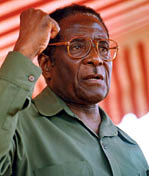
Africa's Hitler?
|
Zimbabwe bomb plot to drive out whites
AN alleged plot to drive most of Zimbabwes 50,000 remaining whites out of the country is being investigated by the Foreign Office.
The Sunday Times has obtained a document, apparently drawn up on the orders of a senior official in President Robert Mugabes secret police, which calls for the bombing of an economic target in Zimbabwe that could be blamed on British funded terrorists.
Diplomatic relations with Britain could then be broken off and all British nationals told to leave within 48 hours or risk being interned as suspected terrorists or terrorist sympathisers, says the document.
It is dated June 8, 2004 and is headed Solution to the White Problem.
Sunday Times
|
|
For the past three years, Zimbabwe has been in crisis. The battle between the increasingly dictatorial and repressive President Robert Mugabe and the opposition has had disastrous economic consequences, with unemployment and inflation running out of control.
While Zimbabweans suffer, all of southern Africa is feeling the repercussions. Trade with what was Africa's breadbasket has come to a standstill and hundreds of thousands of Zimbabweans have fled to neighbouring countries. The question now is why South Africa the regional power and widely seen as the only country that can end the impasse - has so far resisted a strong intervention.
Radio Netherlands
Last week's two-day national labour stayaway against the impending privatisation of South African electricity, telephones, water and transport services was only a mixed success. But combined with other recent regional dynamics and ruling-party convulsions, it adds to the sense that activists are now thoroughly fed up with rampant neoliberalism and the political tyranny that invariably accompanies it on the world's periphery.
To illustrate, the failed neoliberal strategy of Robert Mugabe in Zimbabwe during the 1990s generated malgovernance, rebellions and an opposition movement from the trade unions and urban poor. Since losing a February 2000 referendum, Mugabe responded not only with talk-left/act-right bluster and by activating a paramilitary posing as land-reformers.
He also conclusively cheated on three elections, including last weekend's national poll of rural district municipalities. In more than half the districts, intimidation was so severe that the Movement for Democratic Change (MDC) could not even register their candidates for the 1400 seats. Arrests, beating and torture of MDC supporters were again in evidence, against a backdrop of worsening starvation induced both by drought and venal politics, in which food aid is being used by Mugabe's lieutenants as a weapon and rape of rural women opposed to his regime is also steeply on the rise.
Patrick Bond
|
|
|
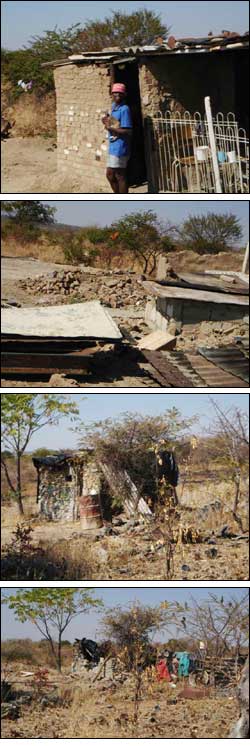
Operation Murambatsvina
On 25 May, Africa Day, the Government of Zimbabwe began an operation labelled "Operation Murambatsvina". While Government has translated this to mean "Operation Clean-up", the more literal translation of "murambatsvina" is "getting rid of the filth". The operation has continued throughout the month of June, and has affected virtually every town and rural business centre in the country. From Mount Darwin in the north, to Beitbridge in the south, Mutare in the East and Bulawayo in the west, no part of the nation has been spared the impact of what could be termed a slow-moving earthquake; every day the nation awakes to find more buildings have fallen around them, more families have been displaced. Families are often having their homes and possessions ruthlessly burnt to the ground, or are given a few hours to remove what they can save before bulldozers come in to demolish entire structures. - sokwanele.com
President Mugabe Bulldozes Homes Of 200,000 Across Zimbabwe
Zimbabwean President Mugabe's Operation Murambatsvina ("Drive out rubbish") has seen at least 200,000 people made homeless in Zimbabwe as the government bulldozes "illegal" homes, buildings and markets.
The opposition has said the operation is designed to "punish" those who object to Mugabe's government. Two children under the age of two have been killed, the first deaths reported so far in the actions which have been taking place for a month now.
International pressure is building on Zimbabwe to stop. British Foreign Minister Jack Straw has been joined by U.S. Secretary of State Condoleezza Rice in condemning the evictions and urging African leaders to speak out.
The government has said the buildings it is destroying are "illegal", and have said that the "black markets" are to blame for the country's "economic meltdown". Over 70% of the population is unemployed.
The bulldozers have the protection of armed police as they do their work. Sometimes the police have forced homeowners to carry out the destruction themselves.
At other times, the government has claimed it is destroying the buildings to get rid of unsafe structures and to reduce overcrowding. Other children have died when the walls of their houses have collapsed. The authorities are also preventing non-governmental organisations from providing aid to those who have lost their homes. The country currently needs to import 1.2 million tonnes of food to avoid famine as rural farming production drops.
Sources
U.S. Secretary of State Condoleezza Rice condemns the evictions ????
What about this Condi? - Eminent domain expanded - Court rules cities can seize homes for economic development
|
South Africa
Imagine you have been living under a racist regime for decades...
In shanty towns, in poverty, in violence and fear...
...and then the militant party who were in solidarity & fought for freedom come into power.
what would you expect to happen?
ANC - the New Labour effect?
The IMF WEF & privatization in South Africa
For critics who believe liberalization is likely to heighten economic inequality (and also mire the country in economic stagnation), there could hardly be a worse time to defer to market forces. South Africa's per capita gross domestic product (GDP) of $2,700 is approximately equal to that of Chile, Brazil and Malaysia, is substantially higher than Poland or Thailand, and is far higher than any other large African country. But with a legacy of apartheid married to extremely skewed, concentrated wealth, South Africa remains characterized by:
dire poverty -- more than half of the population lives in households earning below 300 rand ($72) per month -- highly concentrated in rural areas (in particular, in former "bantustan" homelands in the Eastern Cape, KwaZulu-Natal and the Northern Province) and among women and youth;
extraordinary levels of income inequality (the top 5 percent of the population consume more than the bottom 85 percent), matching Brazil and Nigeria as major countries with the worst distribution of wealth;
ongoing racial bias in income distribution, as 95 percent of the poor are black "African," and 4 percent are "colored" (mixed race), with whites and Indians comprising less than 1 percent of the poor;
inadequate access to basic services, with fewer than one third of Africans having internal taps, flush toilets, electricity and refuse removal; and
a UN Human Development Index (measuring life expectancy, literacy and per capita GDP) for Africans that ranks at approximately the level of the Congo, while the index for whites is at the level of Canada and New Zealand. The national unemployment rate stands between 40 percent and 50 percent, and only 12,000 net jobs have been created during the cyclical upturn that began three years ago, following the longest depression (from 1989 to 1993) in the country's history. Another downturn is likely in 1997, with steady manufacturing job losses likely to intensify.
Patrick Bond
On April 16 in Washington DC, there will be huge demonstrations calling for the shutting down of the IMF and the World Bank. On that day South Africas Finance Minister, Trevor Manuel will be on the other side of the barricades so to speak, chairing the important IMF Governing Board meeting.
It was the same Trevor Manuel, former radical community activist and leader of the United Democratic Front (the radical alliance of peoples organisations that substituted for the ANC in the 1980s when it was banned) that brought Michel Camdessus to SA in 1996 on a speaking tour "to address his critics". "We have invited him to extend the good relations that we have with the IMF... He wants to have discussions with the trade union movement, student organisations as well as the normal constituency such as business people and government leaders."
The background for Camdessus visit includes a history of IMF support for apartheid, including loans of more than US$1 billion to the South African regime during the late 1970s (in the wake of financial panic caused by the Soweto uprising) and early 1980s (when the gold price collapsed and the regime was most urgently in need of external monetary support). From exile, the ANC condemned the IMF for propping up apartheid. The IMF then assisted the regime with its increasingly neoliberal economic policies during the late 1980s, and designed South Africa's Value Added Tax during the early 1990s, leading to mass popular protest.
Brian Ashley
An aspect of the transition from apartheid to democracy in South Africa was inadvertently captured at the opening of the World Economic Forum (WEF) meeting held at the International Convention Centre in Durban, in June 2002, as the police arrived with a massive show of force and drove protesters away from the building with batons and charging horses. One of the organizers of the WEF was approached by an incredulous member of the foreign media and asked about the right to protest in the new South Africa. The organizer pulled out the program and, with a wry smile, pointed to an upcoming session entitled Taking NEPAD to the People. He said he could not understand the protests because the people have been accommodated.
The transition to democracy led by the African National Congress (ANC) was trumped by the transition to neoliberalism. The new ruling elite and the beneficiaries of the old apartheid regime had already made common cause after the ANC came to power in 1994. Now they were cementing their alliance with the corporate raiders in the advanced capitalist world.
Ashwin Desai
|
|
HIV causes AIDS a myth? -
a cover for other diseases caused by poverty, malnutrition,
and an unclean water supply which is a result of
War, corruption & privatization
[neo-liberalism/ corporatism]
|
|
In the late 1980s the media that initially swooned over Gallo became more critical of his ethics and his "discovery" of the AIDS virus. The green monkey story and the "out of Africa" view of AIDS was still widely held, but other theories of AIDS origin were allowed to be expressed.
On May 11, 1987, a highly important AIDS story appeared on the front page of The London Times, one of the world's most respected newspapers. The headline ran, "Smallpox vaccine triggered AIDS virus." Written by science editor Pearce Wright, the story suggested that the smallpox eradication vaccine program sponsored by the World Health Organization (WHO) was responsible for unleashing AIDS in Africa.
Man made from :Gay Today's AIDS Series
Between the years 1966-1977, almost 100 million Blacks living in Central Africa were injected by the WHO. Scientists now speculate that the smallpox vaccine might have awakened a "dormant" AIDS virus infection on the continent.
Pearce Wright noted that the smallpox vaccine connection to AIDS could explain why Brazil, the only South American country covered in the WHO eradication campaign, has the highest incidence of AIDS in that region. In addition, approximately 14,000 Haitians working in Central Africa were inoculated in the smallpox campaign, thus explaining why AIDS also broke out in Haiti.
It is widely believed that Africa is being devastated by a plague of "AIDS." This is in spite of the fact that, according to the World Health Organization's (WHO) Weekly Epidemiological Record, 19 years' worth of AIDS cases for the entire continent of Africa has amounted to only 876,009. (In the US, more people than this die in one year of heart disease.) Africa is generally blamed as the origin of AIDS, yet statistics point towards a more likely source of this disease: the United States.
It was not until 1997 that the cumulative number of AIDS cases in Africa surpassed those in the United States. The most current statistics (November 2000) show that the cumulative tally stands at Africa 876,009 and the United States 733,374 -- not much of a difference considering WHO's estimate that 25.3 million Sub-Saharan Africans have HIV/AIDS, whereas in the United States it is well below one million. Why is there this huge discrepancy? The main reason is many Africans test positive on HIV antibody tests -- while very few Americans do -- and few HIV-positive people in any country go on to develop AIDS.
WHY THE "AIDS TEST" DOESN'T WORK IN AFRICA
|
Why cause instability across a whole continent?
The policy of socio-economic warfare is divide and rule...it allows multinationals [THE GLOBAL CARTEL] access to the worlds biggest resource of oil & mineral deposits
AFRICA: THE NEW OIL AND MILITARY FRONTIER
In January of this year a symposium sponsored by Institute for Advanced Strategic and Political Studies (a Jerusalem based think tank) was held in Washington to discuss "African Oil and U.S. National Security Priorities," as Africa is quickly becoming the new oil frontier for the U.S. According to Ed Royce (R-CA) Chairman of the House Subcommittee on Africa, "African oil should be treated as a priority for U.S. national security post 9-11, and I think that post 9-11 it's occurred to all of us that our traditional sources of oil are not as secure as we once thought they were."
The main product emerging from the symposium was a newly developed working group called the African Oil Policy Initiative Groups (AOPIG) composed of Congressional members, representatives from various offices in the Bush Administration as well as oil companies, U.S. investors and international consultants. AOPIG then created a blueprint for energy investment in Africa that the Administration has been closely following.
AOPIG recommendations are divided into three categories Energy Security, Developmental Strategies, and Regional Security - all encompassing the same theme of securing oil and strategic mineral resources.
Under the title of Regional Security, AOPIG recommends that
1) Congress and the Administration should declare the Gulf of Guinea an area of "Vital Interest to the U.S."
2) A regional sub-command, similar to U.S. Forces in Korea, should be established for the area
3) That regional sub-command should strongly consider the establishment of a regional homeport, possibly on the islands of Sao Tome and Principe
4) A U.S. -Nigerian compact on regional security issues should be established to make the area more secure and thereby more attractive for direct foreign investment.
Additionally, AOPIG has declared that U.S. interest should not be limited to oil. "The Gulf of Guinea, as part of the Atlantic oil-bearing basin, surpasses the Persian Gulf in oil supplies to the U.S. by 2:1; moreover, it maintains significant deposits of critically important strategic mineral including chromium, uranium, cobalt, titanium, diamonds, gold, bauxite, phosphate and copper."
Dena Montague-World policy institute
|
"As Bush creates a corporate protectorate in Iraq, many companies who stand to benefit from reconstruction and oil exploration there are familiar to Africans. Shell, Bechtel and Fluor Corporation are all associated with massacres and crimes against humanity in Africa. Oil giant Shell Corporation had a hand in the death of Ken Saro Wiwa and the massacre of hundreds of Ogoni in the Niger Delta of Nigeria. Bechtel has profited from and exacerbated the ongoing war in the DRC. And Flour Corporation had tight relationships with the Apartheid regime of South Africa. "
War Profiteers, in Africa, as Well as Iraq -Blackstate
|
"Aside from Nigeria, the five biggest oil producers in Africa - in descending order are Algeria, Libya, Egypt and Angola. Angola alone is the ninth largest oil supplier to the U.S. The U.S. currently imports more oil from these six countries than it does from Saudi Arabia. Recent projections by the U.S. National Intelligence Council as reported in The Petroleum Supply Monthly estimate that the proportion of U.S. oil imports from sub-Saharan Africa will reach 25% by 2015."
Saudi Arabia, West Africa -- Next Stops in the Infinite War for Oil
Mike C Ruppert
|
[Karen] Kwiatkowski retired in early 2003, now reporting for lewrockwell.com, criticising Paul Wolfowitz, Donald Rumsfeld and other NeoCons.
"...Referring to the National Intelligence Council's "Global Trends 2015" report, which came out last December, Kwiatkowski pointed out that 25 percent of U.S. oil imports in 2015 will come from sub-Saharan Africa. The prime "energy locations" identified in the study are West Africa, Sudan, and Central Africa..."
It becomes very clear, that the US Interests in Africa are not about yet another "liberation" or "war against terrorism" and definetely not about "a new fight against AIDS".
War in Africa was planned for years Ewing 2001-Global Free press
|
"Little noticed among the Pentagon's plans to radically reshape the U.S. military presence overseas is the groundbreaking possibility of basing thousands of American troops in or around West Africa.
Under discussion: everything from positioning a U.S. aircraft carrier battle group off Africa's vast west coast to establishing one or more forward operating bases in Ghana, Senegal, Mali, Equatorial Guinea or the tiny island nation of Sao Tome and Principe."
U.S. troops may be headed for Africa -Capitol Hill Blue
|
|
Oil flow threatened ahead of Nigeria election - CIA
May 17, 2005 WASHINGTON (Reuters) - Gang violence ahead of Nigeria's 2007 presidential election threatens to disrupt exports from Africa's biggest crude oil producer, an analyst with the U.S. Central Intelligence Agency said on Monday. Nigerian President Olusegun Obasanjo's second term ends in 2007, when he must leave the presidency, according to the constitution rewritten in 1999. That election will be "very contentious" and could bring a repeat of violence and attacks against Western-owned oil installations that marked the run-up to the 2003 election, said Helima Croft, an analyst at the Central Intelligence Agency.
"There are few signs that the region will be more stable in the near-term," Croft said at an event sponsored by the Council on Foreign Relations, where she is a fellow.
Unrest in Nigeria, the world's eighth largest exporter, has been one of the many factors that have kept global oil market traders on edge, along with violence in war-torn Iraq and rampant demand in China and India. Nigeria is an OPEC member and the fifth biggest foreign oil supplier to the U.S. market, shipping an average 1 million barrels a day, according to the Energy Department. Obasanjo's election in 1999 spelled the end of 15 years of military rule in the poverty-stricken nation. But Nigeria under nonmilitary rule has been marred by violence in the nation's oil-rich Niger Delta region, including sabotage and seizure of oil facilities.
"You have a growing criminal element in the oil producing regions," said Croft, pointing to gangs armed with automatic weapons and portable missile-launchers. "There are few signs this criminal enterprise will go away any time soon."
At the depth of the 2003 crisis, 40 percent of the country's output of more than two million bpd was shut.
U.S.-based Chevron was by far the worst hit and 30 percent of its former production is still shut because of extensive vandalism.
Offshore production could be Nigeria's "salvation" because offshore platforms are harder to damage than their onshore counterparts, Croft said.
Recent drilling in Nigeria's new offshore oil exploration area, the focus of a big new licensing round, has been disappointing, a top geologist for ExxonMobil said last month.
Nigeria is one of the few members of the Organization of Petroleum Exporting Countries to have fully opened its oil reserves to the private sector. It aims to increase output from 2.5 to 4.0 million barrels daily by 2010.
- By Chris Baltimore
|
|
How many people have to die of malnutrition before they label it a famine?
|
Crop failure, locusts contribute to critical food shortages
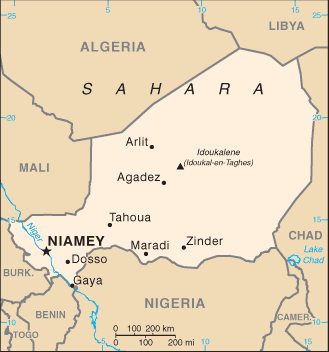
By Marlene Barger NIAMEY, Niger, 8 April 2005 -
Children and families in Niger face critical food shortages in 2005.
Following poor harvests, almost 3.7 million people - half of them children - do not have enough to eat, and this number is expected to grow. Last year, swarms of desert locusts consumed millet and niebe bean crops, and insufficient rainfall damaged harvests and threatened livestock.
There is already evidence that mothers and children are foraging for leaves and breaking into termite mounds in search of the few grains stored there.
Many families count on cereal banks to make grain accessible and affordable in the villages. But the cereal banks are empty. Those who took out loans of grain last year were unable to repay them because their harvests were inadequate. Cereal bank management committees failed to anticipate and prepare for the crisis. - UNICEF
|
|
|
Famine in Niger...
A British aid plane is transporting 41 tons of emergency supplies to malnourished families in the West African country Niger.
Organised by the Charity Save the Children and funded by the Department for International development, the supplies will feed families for one month.
Niger has been hit by locusts and drought bringing grain shortages and increased food prices but why has it taken so long for the country's desperate situation to come to light.
Emergency aid is beginning to get through, but for some children it's too late. The opposition in Niger says the government was reluctant to sound the alarm before the elections last December, not wanting to admit to the voters that they'd failed to feed the poorest members of society.
Others blame donors for not responding to last year's UN appeal.
So why wasn't the endemic crisis in Niger brought up by the Make Poverty History campaigners pressuring the G8 leaders in Scotland just three weeks ago?
- Channel 4
|
|
Oxfam says UN Summit must act to stop Niger food crisis happening again
In September world leaders have the opportunity to prevent food crises like Niger ever happening again, says international aid agency Oxfam.
A $1bn emergency fund is on the agenda of the UN Summit in New York starting on 14 September, which is billed as the biggest meeting of world leaders in history.
If the proposal is agreed to, UN member states would pay into the permanent fund, so that when a country such as Niger needs assistance, money would be available immediately.
3.6 million people, including 800,000 children, face a major food crisis in Niger, however the UN emergency appeal and the World Food Program appeal for the food crisis in West Africa are still not fully funded.
Phil Bloomer, Oxfam's Director of Campaigns and Policy, said: "It is outrageous that the world waits until children are dying before acting to save them. The UN launched their appeal for Niger in November 2004, but it wasn't until international TV crews arrived last week that money really started coming in. The amounts asked for are paltry. A small proportion of the new money pledged at the G8 would cover it. Money for Niger will eventually arrive, but it will be too late for many."
The World Food Program appeal for $16 million is still only 40 per cent funded. The UN emergency appeal for $30 million has only received $10 million, although more has been pledged.
Oxfam says that if this money had been given six months ago, it would have cost $1 per person affected per day to prevent the food crisis in Niger, Mali and Mauritania. It will now take about $80 to save each starving person.
"Starvation does not have to be inevitable. The food crisis in Niger was predicted months ago and could easily have been prevented if funding was immediately available, said Phil Bloomer. "In 50 days time, world leaders must set up a UN emergency fund to stop food crises like Niger ever happening again." - 999today.com
|
|
|
African Development fund say it garauntees its loans...
but does it squeeze the farmer to enable the Multinationals to clear the land ready for another form of harvest?
Guaranteeing Loans and Food Security in Niger
The United Nations Development Program's 2004 Human Development Report ranks Niger as the world's second poorest nation. Most of its 11 million citizens live in semi-arid grasslands and survive on subsistence cultivation of millet, sorghum, and other drought-resistant grains.
Wild annual fluctuations in basic commodity prices have forced many of Niger's farming families into chronic debt. Producers living near the subsistence level must often sell their yields in August and September, the peak months of the harvest season, when local markets are flooded with grain and prices are extremely low. These farmers must then purchase additional food supplies in the "hungry months" of June and July when food is scarce and commodities traders charge exorbitant prices.
|
|
To help local communities develop new routes to food security, ADF has funded cereal bank initiatives in Niger that allow small growers to buy and sell grain at favorable rates through warehouses that are situated in local communities and owned and operated by community-based organizations. Now ADF is helping Eco-Développement Participatif (EDP) transform warehouses in the Maradi District into banks of another sort: locally sustainable credit-lending institutions.
EDP is implementing an innovative "warrantage" system that allows farmers affiliated with a community-based organization (CBO) to store portions of their annual yields at warehouses based in their home villages. These reserves then serve as collateral on cash loans that farmers use to finance income-generating activities during Maradi's seven-month dry season. The farmers can also withdraw and sell their deposits toward the end of the seven-month term, which coincides with the peak period of the annual price cycle.
The sustainability of the EDP warrantage model is guaranteed by a fair but effective credit management process. If a farmer defaults on a loan, the CBO will sell his or her harvest to recoup its loss, and it will return any surplus from the sale to the producer. This system helps prevent spiraling cycles of debt and dependency that have historically forced many families into highly exploitative relationships with private creditors. - ADF
|
The harvest of natural resources and the expansion of the Niger Delta pipelines?
|
resources: uranium, coal, iron ore, tin, phosphates, gold, molybdenum, gypsum, salt, petroleum
The landlocked west African republic of Niger has abundant reserves of uranium and it is this mineral resource upon which the country's economy depends. However, it is also actively promoting its upstream oil potential. Geological research has shown potential oil fields in the country's eastern region in the area where oil fields have been discovered in neighbouring Chad. The international oil companies, Exxon, TG World Energy Inc, and Hunt Oil are currently engaged in exploration activity in Niger.
Its downstream oil industry is wholly dependent on refined petroleum products imported via the port of Cotonou in neighbouring Benin and from the refineries in Nigeria.
The Niger oil industry is regulated by its Ministry of Mines and Energy through the state oil company, Sonidep, which has responsibility for representing the government in all dealings concerning petroleum resources in the country. - mbendi.co.za
Although uranium has historically been Niger's primary mineral product, its gold mining industry is set to grow dramatically based on potential gold mining projects being developed and evaluated by Canadian, Australian and South African mining and exploration companies. Niger's coloured gemstone potential is about to be assessed by Canadian Consolidated Pacific Bay Resources who have secured prospecting rights that covering 20 000 km2. Areas include the Air Massif region in the north, Liptako region in the west and the Damagaram-Mounio, Zinder and Maradi areas in the south. - mbendi.co.za - mining in Niger
|
|
|
7th July = 7 - 7 2005 = 2+0+0+5=7 = 777
|
More Mayhem for London Marks Gains for Gold
By Jon Nones - 21 Jul 2005 at 06:45 PM EDT
St. LOUIS -- Precious metals surged today in light of a currency revaluation in China and explosions in London, boosting gold to its highest closing level since July 12.
"Gold is not normally a 'feel good' purchase. One wants to own it not because 'all is well,'" said Peter Grandich, editor of the Grandich Letter, in recent a Resource Investor article.
"Gold buyers have not considered the terrorism factor for quite a while but now can't ignore it for the foreseeable future," he added.
- resourceinvestor.com
|
What are a 'nations interests?
Well in the Case of Anglo-American Empirical values, it's the plunder of vital resources...
|
Gold -
Gold is used primarily for fabrication and bullion investment and is traded on a world-wide basis. Fabricated gold has a variety of uses, including jewellery, electronics, dentistry, decorations, medals and official coins. Central banks, financial institutions and private individuals buy, sell and hold gold bullion as an investment and as a store of value.
Apart from gold's status as the 'ultimate store of value' (estimates are that the world's central banks hold approximately 33,000 tonnes) the overwhelming use for gold is in jewellery. Over the past decade, demand for gold from the jewellery industry has consistently outstripped newly mined supply. - angloamerican.co.uk
Diamonds
De Beers Consolidated Mines Limited ("DBCM") is the ultimate parent company in South Africa. The major diamond assets of DBCM consists of the South African diamond mines owned and operated by De Beers and interests in the South African elements of the DTC, De Beers' marketing arm.
De Beers Centenary AG (DBCAG) is the ultimate parent company outside of South Africa. angloamerican.co.uk
Gold is also a SUPERCONDUCTOR
In 1997 researchers discovered that at a temperature very near absolute zero an alloy of gold and indium was both a superconductor and a natural magnet. Conventional wisdom held that a material with such properties could not exist! - source
|
|
Project 777 -
Hudson Bay Mining and Smelting (HBMS) completed the final phase of the 777 Project, the development of the 777 mine. The $400 million project, which commenced in 2000, consisted of 6 components. This included expansion and upgrading projects at the Flin Flon metallurgical plant and development of two new underground mines. The 777 mine reached full production of 1 million tonnes per year in January 2004. The deposit contains mineable reserves of 14.5 million tonnes grading 4.56% zinc and 2.5% copper, and significant precious metal credits. Hudson Bay Exploration conducted geophysics and drilling of SPECTREM airborne targets in the Flin Flon-Snow Lake belt and beneath the Paleozoic in the Hargrave Lake-Moose Lake area. Drilling was also carried out in the vicinity of current and past producing mines. - www.gov.mb.ca
Hudson Bay Mining and Smelting Company US$240m Approval for 777 Project | 22 September 1999
|
|
|
G8 debt deal under threat at IMF
By Steve Schifferes - BBC News economics reporter - Friday, 15 July, 2005
Even before the ink has dried on proposals to relieve poor countries' debts to international lenders, the deal agreed by the G8 at Gleneagles is under threat.
A number of European governments are apparently having second thoughts about proposals for debt relief which formed a key part of the help world leaders offered to Africa at last week's summit.
" These proposals are in direct contradiction to what millions of campaigners and poor people were told by the G8 " -
Stephen Rand,
Jubilee Debt Campaign
The Belgians have apparently proposed changing the terms of the deal to give lenders more leverage over poor countries than they would have if they simply wrote off 100% of their debt.
In a document that has been leaked to the activist group Jubilee Debt Campaign, Belgian IMF representative Willy Kierkens is quoted as telling the IMF executive board that "rather than giving full, irrevocable and unconditional debt relief... countries would receive grants".
The IMF would then be able to withdraw the grants if countries failed to meet IMF conditions such as implementing the Poverty Growth Reduction Strategy which is a pre-requisite for receiving debt relief.
The head of the Jubilee Debt Campaign, Stephen Rand, says: "These proposals are in direct contradiction to what millions of campaigners and poor people were told by the G8."
The proposals have also alarmed African officials at the IMF, if the leaks are accurate. The three African directors representing sub-Saharan Africa say any change to the G8 debt deal "would delay benefits" and that it "does not seem appropriate that debt cancellation would reintroduce conditionality".
Britain is against changing the terms of the deal agreed at Gleneagles, a UK spokeswoman said. The Gleneagles deal aims to foster good governance and root out corruption among governments receiving aid, she added. Mr Kierkens was travelling in Europe and unavailable for comment, his Washington office told the BBC. The IMF had been expected to approve its part of the deal at its annual meeting in Washington in September.
Politics of aid
If the G8 countries stick to their guns, it is unlikely that the smaller nations on the IMF can derail the deal. But as it only takes 15% of the votes on the IMF to block a deal, the attitude of larger G8 countries like Germany and Japan will be crucial. Although they signed the debt deal at a meeting of G8 finance ministers in June, the Germans in particular were known to be unhappy with the plan for complete debt cancellation.
They are believed to have argued that this would create a moral hazard, with the poor countries who borrowed irresponsibly being rewarded, while other countries like Botswana who prudently avoided international borrowing receiving less aid. And there is also the problem of funding the debt deal.
Funding
While the G8 finance ministers agreed to fully fund the World Bank and African Development Bank portion of the deal, there was a fudge when it came to paying for debt relief in relation to the IMF. The finance ministers' statement says that the IMF debt relief "should be met by the use of existing IMF resources".
But, it adds, "in situations where other existing and projected debt relief obligations cannot be met form existing resources, donors commit to provide the additional resources necessary" on a "fair-burden sharing basis".
At the G8 press conference, UK Chancellor Gordon Brown suggested that the IMF had found additional resources by revaluing its gold reserves. And indeed the Belgians say that the total cost of the deal may be as much as 4.1bn SDR ($2.4bn) and suggest selling up to 2bn SDR ($1.2bn) worth of IMF gold to finance debt relief. This is likely to be blocked by the US and Canada, who fear it will hurt their domestic gold producers.
Slow pace
Many activists have been disappointed by the slow pace of debt relief since campaigning began a decade ago.
That it has taken so long to get agreement on the multi-lateral deal is a reflection of the deep disagreements among the major industrial countries - and the slow pace at which such relief has been administered. And the US has been reluctant to put up additional funds to pay for the World Bank's share of any debt relief. It took high-level negotiations between Tony Blair and US President George W Bush to change this position - and open the way to a deal.
It probably helped that sums involved in debt relief are relatively modest - with the US, for example, expected to put in just $175m a year over 10 years.
The debt deal is worth around $1.5bn - critical sums to some very poor countries, but only 3% of total aid flows of $50bn per year. And the amount is also modest because so few poor countries - just 18, perhaps rising to 27 in a few years - qualify for debt relief under the Highly Indebted Poor Country (HIPC) initiative. - BBC
|
Further reading on the corporate carve-up of Global resources:
|
Probe begins into Nigeria plane tragedy
Last Modified: 24 Oct 2005 Source: ITN - The sad task of recovering the bodies and excavating the wreckage of the Nigerian passenger jet that crashed killing 117 people has begun.
Investigators are working on the theory that the Boeing 737 nosedived into a marsh north of Lagos on Saturday night and most of the fuselage and victims of the crash are now buried beneath the impact zone.
Dismembered and burned body parts, fuselage fragments and engine parts are strewn over an area the size of four football fields around Lissa village, but much of the plane and many bodies appeared to be missing.
Aviation Minister Babalola Borishade said he had asked foreign construction companies to help dig out the crater, which was still emitting a pungent smoke on Monday morning.
Fingers, part of a foot and other unidentified pieces of human flesh are still visible amid mangled metal and personal papers at the crash site.
Bellview Airlines flight 210 lost contact with the control tower three minutes after take-off from Lagos en route to Abuja in a heavy electrical storm. The pilot made a distress call shortly afterwards, indicating a technical problem. It took emergency services 15 hours to locate the crash site. The black box containing vital information from the plane's flight deck has yet to be recovered. -channel4
|
|
Blasts heard in Republic of Congo capital
BRAZZAVILLE, Republic of Congo (AP) -- Explosions and gunfire sounded briefly in the Republic of Congo's capital for the second time in a week as security forces launched an operation Wednesday against former rebels who have failed to lay down arms since a 2003 peace deal.
As booms echoed in the center of the city, pupils ran from schools, shopkeepers closed their stores and the streets were full of people heading home. State television, headquartered in the stricken neighborhood, was off the air. Residents reported at least three heavy detonations and exchanges of gunfire over a half-hour period in Brazzaville's Bacongo neighborhood, a stronghold of ex-rebels loyal to renegade Pastor Frederic Bitsangou.
Clashes between the two sides broke out in the area last week leaving six dead, one day before former Prime Minister Bernard Kolelas returned from an eight-year exile to bury his wife. Kolelas, who is still in Brazzaville, led the so-called Ninja rebels during back-to-back wars in the late 1990s before Bitsangou took over the group's leadership.
A senior army intelligence officer, speaking on condition of anonymity because he is not permitted to speak publicly to the press, said the army had launched an operation to clean rebel fighters from the area. He said troops had encircled Bitsangou's Brazzaville residence, home to top rebel officials. Bitsangou is not in the capital. He lives in his stronghold in Vinza, 60 miles (100 kilometers) to the northwest.
Sylvie Monka, a university student who fled southern Brazzaville on Wednesday, said she heard gunfire for around half an hour around the state television headquarters. She said streets were empty except for military units, who ordered residents to clear out of the area Tuesday.
Ninja rebels first took up arms in the late 1990s. They agreed to a 1999 cease-fire that ended two years of fierce fighting that included artillery barrages in Brazzaville. After President Denis Sassou-Nguesso won a 2002 presidential race that international observers deemed fair, the rebels took up arms again, but fighting ended with a new peace deal in March 2003. The Ninjas vowed to disarm after the accord but fought briefly with government security forces on Thursday, and their southern strongholds have remained tense. In 2000, a Brazzaville court sentenced Kolelas to death in absentia for a range of crimes committed by his militia, including torture and the rape of prisoners during the nation's bloody five-month civil war in 1997.
President Denis Sassou-Nguesso said this month that Kolelas could return to bury his spouse, Jacqueline, who died in France last month after suffering a brain hemorrhage. - CNN
|
|
LIBERIA: Africa finally gets first female president as defeated soccer tsar calls for peace
MONROVIA, 15 November (IRIN) - Africa won its first female president on Tuesday when counting ended in Liberia's historic presidential poll, with former World Bank economist Ellen Johnson-Sirleaf garnering 59.4 percent against former soccer star George Weah.
"Ellen Johnson-Sirleaf has received 4778,526 votes corresponding to 59.4 percent and George Weah has received 327,046 votes corresponding to 40.6 percent," said the head of the election commission, Frances Johnson-Morris.
While Weah continued to cry foul and demand a reassessment of the count, he also issued a plea to his supporters to keep their dismay off the streets for the good "of our fragile peace" and said he would challenge the results through the legal process.
Tuesday's provisional results were based on a tally of all votes but a final official result is expected only next week. Johnson-Morris said the tally would have to be verified and reconciled by the Commission before it is declared final.
The presidential poll, held under the watchful eye of international observers and some 15,000 UN peacekeeping troops, was slated to seal the peace on a brutal 14-year civil war that ended in 2003.
Weah, a former FIFA footballer of the year who won most of the votes in the first round of the two-round ballot, on Tuesday reiterated his claims of "massive fraud" in the run-off. On Friday, as Weah filed a petition to the Supreme Court to allege fraud, hundreds of his supporters protested in the streets chanting "No Weah, No Peace". They also staged sit-in protests before the offices of the United Nations Mission in Liberia (UNMIL), the European Union and the 15-nation West African regional block, ECOWAS that two years ago brokered the country's peace, in a bid to have the final results annulled.
But Johnson-Morris said: "I have no authority, nor does the commission, to overturn the elections results which reflect the will of the Liberian people." According to Johnson-Morris, 805, 572 people, or 60 percent of the electorate turned out to vote last week.
Weah in a statement broadcast on his privately-owned radio station KINGS FM on Tuesday, a copy of which was given to IRIN, said his party Congress for Democratic Change (CDC) had been "cheated and there is strong evidence that the run-off elections were rigged". His statement said ballot papers were pre-marked in favour of his rival Ellen Johnson-Sirleaf and the commission tally sheets in his party's possession "shows this pervaded the entire process". But he ordered a halt to all street protest by his supporters saying he would follow legal procedures to channel his fraud allegations.
"Public demonstrations in the streets of Monrovia or elsewhere in protest of the run-off election results is not expedient; it is not good for our fragile peace; it might even be counter-productive to the legal bid we have put in motion at the National Elections Commission," Weah said.
The commission head said public hearings into Weah's complaints would start on Wednesday. Diplomats and observers have been meeting with Weah to investigate his fraud claims. Some 18 members of his party, the Congress for Democratic Change (CDC), which is the best represented in a fragmented parliament, have said that they will not take their seats unless the fraud allegations are adequately addressed.
International observers meanwhile have declared the elections broadly free and fair and ECOWAS has urged Weah's supporters to accept the results with dignity and grace. - alertnet.org
|
|
Natural Gas The Future Of Africa's Energy Security Needs, Conference Told
Natural gas is seen as a "greener" alternative to oil and its usage is being mooted to combat the effects of global warming.
Maputo (AFP) Jun 03, 2005 - Natural gas in Africa will play a major role in the future of the continent's energy needs and can be used in wide-ranging roles from household cooking to generating electricity at power stations, an African energy expert said Friday.
"Diversification is essential in improving energy security in Africa... and natural gas has become an essential part in the continent's energy consumption," said Hussein ElHag, executive director of the Africa Energy Commission, based in Algeria. "Gas can be used in many functions, from heating in household cooking to the generation of electricity," ElHag said, speaking at a four-day conference in the Mozambican capital.
Firewood remained the continent's major source of energy, UN Conference on Trade and Development financial risk and commodities chief, Lamon Rutten, said Monday, adding that some 85 percent of the continent's population did not have access to electricity. Natural gas is seen as a "greener" alternative to oil and its usage is being mooted to combat the effects of global warming.
"Natural gas presents an alternative to deforestation, it will also help prevent desertification in countries like Sudan," said ElHag. "Sudan for instance, is only concentrating on oil but there is gas onshore and offshore, they need to think of natural gas to combat desertification," he said.
Algeria was the continent's largest producer of gas, with some 61 percent of Africa's total production of 141 billion cubic metres, followed by Egypt, Nigeria and Libya. But new gas fields are constantly being explored, including the Pande and Temane gas fields in Mozambique which is connected by pipeline to South Africa, as well as the Kudu gas field off the Namibian coast, the conference heard. Countries like Sudan, Tanzania and Mauritania also hold some signifcant gas reserves. The Algiers-based Africa Energy Commission, has proposed an African Gas Market Agreement, calling for a giant continental market in which the commodity could be traded within states on the continent.
"We need to improve energy security in Africa through a continental integrated gas industry," ElHag said. But gas still played a second-fiddle to oil, he said. "The biggest problem is that there is widespread thinking that gas is the baby of oil. We need to 'delink' the two commodities if we want to move forward." - spacemart.com
|
|
China, Japan Vie For African Oil
By Andrea R. Mihailescu - UPI Energy Correspondent - Washington (UPI) Nov 17, 2005
China and Japan are vying for energy supplies around the globe, but African resources are of particular interest to the two rivals. In addition to the rivalry over energy interests in the East China Sea, Russia, Central Asia and Southeast Asia in 2004, China surpassed Japan as the second-largest importer of African oil following the United States, studies showed. Japan's African energy supplies rose by nearly 20 percent in 2004, while China's imports grew by more than 35 percent. Surpassed as the world's second-largest oil consumer in 2003 by China, Japan has emerged as the world's fourth-largest energy consumer and second-largest energy importer, after the United States, according the U.S. Energy Information Administration. While experiencing a period of slow economic growth over the past decade, Japan assumed a number of steps toward economic deregulation and restructuring as renewed economic growth last year could lead to higher energy demand, the EIA said.
Since the bulk of its oil comes from the Organization of Petroleum Exporting Countries, particularly the Persian Gulf, Japan has sought to diversify its oil import sources away from the Middle East but with little success, due to increasing competition from China and India.
Political differences have distanced Japan from many African nations, especially at the United Nations, while China has supported the position of African nations on Security Council reform and opposes Japan's membership on the body. By aiming to secure control of African energy resources, China has pursued a policy that is focused on bilateral ties with oil-producing nations, by fostering relationships with African elites, which helps its state-owned oil firms facilitate activities in exploration, extraction, processing and shipping African petroleum.
China receives approximately 25 percent of its oil from Sudan, Chad, Libya, Nigeria, Algeria, Gabon and Angola. Other African nations, such as Equatorial Guinea, are looking to increase or strengthen economic relations with China. Individually, these countries form a small share of Chinese imports, but the supplies create a significant share of the exports of the African oil-producing nations. Sudan exports 60 percent of its oil to China, Angola exports 25 percent of its crude, and the remaining countries export a significant percentage of their energy resources.
Chinese oil firms are providing capital, technology and expertise for Sudan's oil fields, United Press International reported in July. Beijing's growing investments give Sudan cash and allow it to resist pressure from the West. With increasing investment in its African resources, China's capital has allowed it to seriously affect the political and social development of these countries. In addition to oil, China increased investment and trade with African nations. It supplied Nigeria and Zimbabwe with fighter jets and pursued trade relations with Southern African Development Community countries, local media reported.
China's financial and military support to Sudan during its civil war and violence in Darfur was criticized by many Western nations. China espouses a policy of non-interference in African internal affairs. China is also reluctant in joining the United States when it condemns human-rights violations, which often causes tension between Washington and Beijing. U.S. sanctions on African countries instead provide an opportunity for China to further its economic ties to the continent.
Much of China's capital targets infrastructure projects facilitating development of the oil industry. Industry experts say China's financial assistance encouraged Angola to decline loans from the International Monetary Fund that would force it to be accountable in how it allocates earned oil revenues. If it were to open its books, Angola might have to reform.
The Japanese media has scrutinized China's approaches to securing its African energy resources by reporting that Chinese business methods espouse terrorism and anti-democratic African nations. But as the Bush administration continues to support a policy of spreading democracy and aims to increase energy supplies from sources outside the Middle East, Africa has the potential to become a growing and important supplier and its relations with China will become increasingly critical.
California Gov. Arnold Schwarzenegger said during his visit to Beijing earlier this week it is important for the United States and China -- the world's two largest energy consumers -- to strengthen ties in the energy industry as their demand for energy resources increases. Diversifying supplies to ensure supplies will meet demand, while ameliorating disruptions, will be the next greatest challenges energy consumers will have to face.
- spacewar.com
|
|
Eritrea says Ethiopia stokes border fears as ploy
NAIROBI, Nov 21 (Reuters) - Eritrea's president has accused Ethiopia of raising the spectre of renewed conflict between the two neighbours over their disputed border as a ploy to distract attention from Ethiopia's domestic troubles.
Military manoeuvres on both sides of an unmarked 1,000 km (620 mile) frontier between the feuding Horn of Africa neighbours have raised international concern about a possible repeat of their 1998-2000 border war that killed 70,000 people.
The growing tension along the border coincided with protests in Ethiopia over a May 15 election the opposition says was rigged, but which Prime Minister Meles Zenawi's government says was fair.
Ethiopian authorities have accused Eritrea of supporting the biggest opposition party, the Coalition for Unity and Democracy, whose leaders face treason charges and are accused of inciting the violence in which more than 40 people died.
In an interview with local media late on Saturday, Eritrean President Isaias Afewerki dismissed the Ethiopian claims as a "baseless allegation", the Information Ministry said.
"President Isaias Afewerki underlined that statements about the resumption of imminent war between Eritrea and Ethiopia are the invention of the TPLF and its collaborators designed to divert (attention from) the prevailing internal crisis in Ethiopia," it said.
The ministry was referring to Meles' former rebel movement, the Tigrayan People's Liberation Front.
Isaias said that "in a bid to escape from the current internal crisis it is facing, the TPLF regime is resorting to war as an alternative".
Ethiopian officials were not immediately available for comment.
Eritrea has grown frustrated at the international community's failure to pressure Ethiopia to implement a border ruling by an independent commission.
Under a 2000 peace deal, both sides agreed to accept the commission's decision about the location of the frontier as final. But when the commission in 2002 awarded the flashpoint town of Badme to Eritrea, Addis Ababa rejected the ruling.
The Eritrean statement, on the official Web site www.shabait.com, warned that the country's patience over the border issue was running out.
Both Ethiopia and Eritrea have said they will not be provoked by the other side into starting a new war. Top military brass from both sides are expected in Kenya this week to discuss border tensions and troop movements. - alertnet
|
|
Interpol chiefs warn of bioterror attack risk
21/11/2005 - The heads of the international police organisation Interpol today warned that a bioterrorist attack is not a case of "if" but "when," citing threats by the al-Qaida network to use biological weapons to kill millions of people.
South African police chief Jackie Selebi, president of Interpol, said there was a need for much more global cooperation to reduce the threat.
"Interpol believes the risks of bioterrorism are so momentous that the police and the public health communities must break down the barriers preventing close collaboration," said Interpol Secretary General Ronald Noble.
Interpol is holding a three-day bioterrorism workshop for African law enforcement chiefs.
- IOL
|
|
17 held as Moroccan police smash terror network
21/11/2005 - Moroccan police have dismantled a terrorist network, arresting 17 people, including two former prisoners at the US base at Cuba's Guantanamo Bay reported. At least some of the suspects were linked to al-Qaida in Iraq, it was reported.
Brahim Benchekroun and Mohammed Mazouz - among five Moroccans freed from Guantanamo Bay in August 2004 - were among the suspects, the official MAP news agency said yesterday. They were arrested on November 11 at their homes in connection with a probe into al-Qaida, a Moroccan security official said.
Information about the network, dismantled before it was fully structured, remained sketchy, and it was unclear when the 15 other arrests were made. The top two suspects, Khaled Azig and Mohamed R'ha, were recruiting extremists for their cause, MAP quoted police as saying. Members of the network had links with small groups on the Iraqi border and close ties to leading members of the al-Qaida terror network, MAP reported.
No details were provided, including the exact nature of the link to al-Qaida.
Al-Qaida in Iraq is reportedly holding two Moroccan embassy employees, Abdelkrim el-Mouhafidi and his driver, Abderrahim Boualam. They disappeared on October 20 while driving to Baghdad from Jordan. Morocco's intelligence services have been tracking Azig, one of the two lead suspects in the network, since March. The Moroccan once studied theology in Syria and made frequent trips to Turkey, but returned to Morocco in June, police said. Azig was joined on September 29 by R'ha, a Belgian of Moroccan origin known to have close ties with North Africans in Europe. He had also made trips to Syria, MAP reported.
The two men were in the process of recruiting Islamic extremists when their efforts were cut short by the arrests, the agency said. Benchekroun and Mazouz, the former Guantanamo prisoners, were among those being recruited, according to police. Arrested in Pakistan and Afghanistan in late 2001, they were among five Moroccans accused of taking training courses in how to handle firearms and make explosives. |
|
Nicolas Sarkozy
|
A suspected former bodyguard of al-Qaida leader Osama bin Laden, Abdellah Tabarak, was one of the five released. Turned over to Moroccan authorities in August 2004, after two years and eight months in the US detention camp, the five were given provisional freedom. The five all face trial.
Morocco has been tracking Islamic extremists since bombing attacks in Casablanca in 2003 killed 45 people - 13 of them suicide bombers. The Moroccan Islamic Combatant Group is suspected in the bombings that authorities have said were linked to al-Qaida.
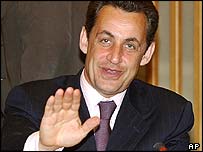
The arrests were announced hours after French interior minister Nicolas Sarkozy concluded a meeting with his Moroccan counterpart, Mustapha Sahel, devoted mainly to the fight against terrorism. - IOL
|
|
Zambia in Crisis
The Government of Zambia has declared the current food shortfall a disaster and appealed to the donor community for assistance with its relief efforts. The VAC has estimated food aid needs through March 2006. Major food aid distributions after this time are likely to compromise the harvest in April and May. New phytosanitary import regulations imposed on maize have delayed maize imports from South Africa. This has led to higher prices being offered by the large traders, and, consequently, higher maize meal prices for urban consumers. Although maize and meal prices are higher than last season, in real terms they have not reached the high levels of the 2002, the last food crisis year. Recorded informal imports from Tanzania have significantly increased in the last few months, while exports to the DRC have declined.
- alertnet.org
|
|
KENYA: Drought-related deaths in the northeast
NAIROBI, 22 December (IRIN) - Several people have died of drought-related causes in Mandera district in Kenya's Northeastern Province, where a prolonged dry spell has led to high levels of malnutrition and livestock deaths, officials said on Thursday.
"The situation is getting worse. Several people have died not as a direct result of starvation but of complications related to malnutrition and the use of contaminated water," said Paul Chemutut, the district officer in charge of Mandera.
About 70 percent of Mandera's 300,000 population was in need of humanitarian assistance, he added. The arid district is largely inhabited by ethnic Somalis, most of whom are nomadic pastoralists.
James Kobia, the government officer in charge of Mandera's El Wak Division, said four people had died in his division. "Children and old people are very weak, and many of them are falling sick because they do not have enough to eat," he said. Kobia said the government was distributing rations of maize, beans and milk powder once a month to about 40 percent of El Wak's 50,000 people, but it was not enough because almost everybody was in need. "We are appealing to humanitarian agencies to come and help us because the situation is getting out of control," he added.
Ahmed Mohammed Abdi, a disaster response officer with the Kenya Red Cross Society (KRCS), said most wells had dried up and people had congregated around the few working boreholes, which kept breaking down because of overuse. The government, he added, had provided seven water tankers but more were needed.
Abdi said the KRCS would embark on an exercise to "buy and slaughter" weakened livestock in Mandera on Friday, so that herders could earn some income. The meat would be distributed to the most vulnerable families. He said the worst affected areas were El Wak and Takaba divisions.
The Kenyan government has appealed for urgent food aid, saying hundreds of thousands of people in arid and semi-arid areas in the east and northeast will go hungry because of the failure of the short rains.
On 16 December, the UN World Food Programme warned that the number of people in need of food in Kenya could rise to 2.5 million in the first half of 2006 because the October-December short rains had failed in many eastern and northern districts. - alertnet.org
|
|
SOMALIA: Two million facing food crisis in the south
NAIROBI, 22 December (IRIN) - An estimated two million people in southern Somalia are facing an imminent humanitarian emergency and acute livelihood crisis over the next six months, the UN Food and Agriculture Organization (FAO) has warned.
"Somalia is experiencing a dangerous confluence of factors that almost certainly will lead to rapidly plummeting humanitarian conditions throughout southern regions," FAO said in a statement on Wednesday.
Nick Haan, the chief technical adviser for the Food Security and Analysis Unit (FSAU) Somalia, said that as the rainy season came to an end, it was clear that "the situation is going to evolve into a humanitarian emergency that could deteriorate as early as next month". Haan said a poor rainy season, localised resource-based conflict, market disruption and internal tensions had all combined to create the current situation. "Malnutrition levels as high as 20 percent in some areas of the south have reduced the resilience of the population to shocks," he added.
FSAU provides analysis of Somalia's food, nutrition and livelihood situation in order to promote food and livelihood security and is implemented by FAO.
"This year's main cereal harvest in July was the worst in a decade," FAO said.
The current projections, it noted, were in addition to ongoing humanitarian emergencies in Gedo and Lower Juba: "The failed Deyr (October-December rainy season) will both expand and make these crises more severe." "Humanitarian actors have limited access to some areas most critically in need of assistance," it added. "Further, the upsurge of piracy off the Somali coast limits food supply lines for both commercial and humanitarian imports."
Philippe Lazzarini, head of the UN Office for the Coordination of Humanitarian Affairs, Somalia, said it was imperative that the international community beefed up its operational capacity, particularly in southcentral Somalia, where access is difficult.
"There is an urgency to mobilise partners to address the existing need and to better approach the additional need that has been forecast," he said. "We are on the eve of a new humanitarian crisis." - alertnet.org
|
|
Congo, UN troops battle militia in lawless east
By David Lewis - KINSHASA, Dec 22 (Reuters) - U.N. and Congolese forces launched a major operation against a local militia on Thursday to try to assert government control over the lawless east, days after a landmark vote on a post-war constitution, the U.N. said. A U.N. spokesman said a government soldier and seven militiamen were killed when hundreds of Nepalese U.N. peacekeepers and some 1,500 Congolese soldiers, backed up by helicopter gunships, clashed with militiamen near Fataki, around 75 km (50 miles) north of Bunia, in Ituri province. Another U.N. official said nine Congolese troops were killed in separate fighting on Wednesday with another ethnic militia near Boga, 80 km southwest of Bunia.
The clashes highlighted insecurity in the east days after millions voted in Congo's first free national poll in 40 years. U.N. military operations across the country ceased in the run-up to the poll to allow as many people as possible to vote.
Latest results released on Thursday showed that with nearly 60 percent of polling stations counted, the "yes" vote had just over 80 percent -- which appeared to guarantee the adoption of a constitution paving the way for elections in 2006.
"There is a major operation going on at the moment; 375 of our men and 1,500 Congolese soldiers are carrying out an operation to restore the rule of law," said Major Hans-Jakob Reichen, a military spokesman for the U.N. peacekeeping force. "Clashes are taking place and the U.N. is giving fire support," Reichen said. "So far one Congolese soldier has died and seven militiamen have been killed."
He said the militiamen were Lendu fighters who refused to join a U.N.-backed disarmament process and are accused of atrocities against civilians.
Near Boga, another local ethnic militia fought a bloody battle with government troops, a U.N. official said. "There was fighting between the Congolese army and other militia fighters near Boga yesterday. Nine government soldiers were killed and another 30 are injured, three of them seriously. We are told about 30 militiamen were killed," the official said.
MILITIAMEN REFUSE TO DISARM
The world's biggest U.N. peacekeeping force is trying to restore peace to the Democratic Republic of Congo after the five-year war, which is estimated to have killed nearly 4 million people, mainly through hunger and disease. The war officially ended in 2003, but bands of gunmen still terrorise civilians in large areas of the country, particularly eastern areas whose mineral riches are believed to have fuelled a conflict that at one point drew in six foreign armies.
Often accused of failing to protect civilians in Congo's eastern Ituri province, this year the U.N. force has carried out more robust operations with a new Congolese army drawn from the ranks of former rebel movements and existing government forces.
Some 15,000 fighters signed up to the disarmament process in Ituri but several thousand are believed to have remained in the bush, persecuting civilians and resisting efforts to re-establish central government authority.
The U.N. Security Council stepped up a drive on Wednesday to rid eastern Congo of Rwandan Hutu rebels who have hidden out in the area for over a decade and terrorised local civilians.
It authorised U.N. sanctions to be imposed on the leaders of armed groups in Congo who have failed to fulfil promises to disarm and leave the country or prevented others from doing so.
Hutu rebels fled to Congo after helping to carry out the 1994 Rwandan genocide in which 800,000 minority Tutsis and politically moderate Hutus were killed. - alertnet.org
|
|
Flashback 2002: World Bank supports African pipeline
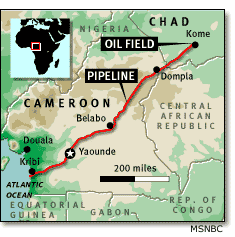
The World Bank is continuing to support a controversial oil pipeline project between Chad and Cameroon despite criticism by independent inspectors.
The inspectors claimed the project was harming the environment and failing to meet some objectives. But a report defending the Bank's role and rejecting the inspectors findings will be discussed on Thursday by its shareholders, including its biggest shareholder - the US.
"Management believes that the bank has made exceptional efforts to apply its policies and procedures and to pursue concretely its mission statement," said Reuters quoting the report. "Given these actions, management does not agree that, as a result, the requestors' rights or interests have been, or will be, directly and adversely affect by these projects," it added.
Non-governmental organizations and environmental groups have already criticized the Bank's response.
Credibility gap?
The Bank is providing $140m (£90.2m) of the $4bn needed to develop the oil fields in southern Chad and to build a 1,050 km pipeline to an offshore oil-loading facility off Cameroon's coast. It is the largest US investment project in Africa. The funding is critical to the credibility of the project, which is led by US oil company Exxon Mobil and includes ChevronTexaco and Malaysia's Petronas. The report rejected inspectors claims that the environmental impact study was inadequate and that allocating just 5% of revenues to Chad was too little. It would be unprecedented for the Bank to pull out at this stage of the project.
Pipeline progress
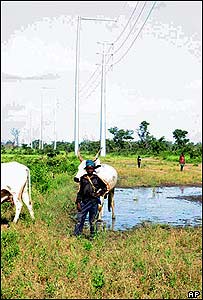
The state-owned Cameroon Tribune newspaper has reported that by 7 June, almost 20 months into the project, 425 km of pipe had been laid; 450 km of road had been renovated or built, including 11 bridges; and optic fibre cable has been laid alongside the pipe. The paper said £4m ($6.2m; 4bn CFA francs) had been paid out in individual compensation and 1bn CFA francs given to community projects. Six thousand people have been employed on the project, including 5,500 Cameroonians.
- news.bbc.co.uk
|
|
|
THE PROJECT
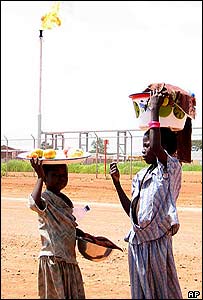
The Chad Oil and Pipeline Project is a $3.7 billion development project comprising some 300 oil wells, which are expected to extract approximately one billion barrels of oil over twenty-five years. Located in Chad's southwestern region, it is one of Africa's largest public/private development projects. Once extracted, the oil will be transported by a 640 mile underground pipeline, through neighboring Cameroon, to an offshore export loading facility. Construction began in October 2000 and the oil is expected to flow in 2004. Project ownership is comprised of a three-company oil consortium (Exxon/Mobil 40%, Petronas Malaysia 35% and Chevron 25%) and the governments of Chad and Cameroon, which hold a combined 3% stake in the pipeline portion of the project. The funds used to secure the investment share of the two countries were provided in the form of a loan by the World Bank. Exxon/Mobil, operating under the name EssoChad, is the project's construction and operations manager.
|
THE COUNTRY
Chad is a landlocked country in north-central Africa. It is among the world's poorest countries, a condition aggravated by various civil wars during thirty of its forty years of independence from France. Political stability has been hindered by tensions between the Muslim populations in the north and non-Muslim populations in the south, as well as by conflicts within each population. The political conflicts, coupled with its limited natural resources, have resulted in minimal private investment. The country is governed by an elected President, Idris Deby, a Muslim from the north who seized power in 1990 and was elected for a five-year term in June 2001. The current Constitution was passed by referendum in 1995 and a constitutional court began to hear cases in 2000. Chad's legal system is based on customary law, French civil law and now the provisions of the new Constitution. It has not accept compulsory International Court of Justice (ICJ) jurisdiction. 125 four year seats are available in the country's single-house legislature, which will held elections in late 2001.
|
|
|
THE ECONOMY
As one of the ten poorest countries in the world, Chad's economic development is challenged by its landlocked geography and the desert climate in the northern half of the state. In 2000, GDP was estimated at $8.1 billion with an expected real growth rate of 4% and an inflation rate of 3%. Per capita GDP was $1000. Most of the population (85%) worked in agriculture, often on the subsistence level. According to a 1995 estimate 64% of the population lives below the poverty line, receiving inadequate health care and educational opportunities. Economic factors undoubtedly contribute to the fact that Chad has 1:30,000 doctor to patient ratio and an adult illiteracy rate of 80% (people over the age of fifteen illiterate in French or Arabic). Life expectancy is approximately 50 years (48.86 years for males and 52.98 years for females) and the infant mortality rate is 95.06 deaths/1,000 live births (2001 est.).
Chad is said to be one of the few countries in the world never to have a railroad, and with less than 200 miles of paved roads in one of Africa's largest countries, its road infrastructure is poor. The communications system is also underdeveloped. A 1997 estimate by the CIA claims Chad has only 7000 main phone lines in use. Internet access is even worse: 1 server used by an estimated 1000 people out of a population of 8,707,078 (2000 estimate). The UNDP Human Development Report for 2000, ranks Chad eighth from the bottom of the 174 countries surveyed.
SOCIAL CONDITIONS IN CHAD PRIOR TO THE OIL PROJECT
Since receiving independence from France in 1960, nation-building in Chad has been hindered by civil wars largely stemming from competition among ethnically-defined groups seeking overall political power. There has also been external interference from Libya in the north. Traditionally in Chad political power holders governed local resources such as grazing rights, water, and land for agricultural cultivation.
|
|
|
Women in Chad and Cameroon often walk long distances to gather water for drinking, cooking, and other everyday activities. http://www.esso.com/eaff/essochad/
Today the group in control of the country administers all the nation's natural resources and designs and implements all social, economic and political policies, including the use of external aid. Competition for this power has undermined other efforts to unite disparate tribal cultures under a single state authority based on pluralism, rule of law, and a just distribution of resources, power and authority based on constitutional democracy. These political ideals have remained on the horizon as each successive president sought to centralize power in his office. Recent changes in communications and growth in the numbers of local NGOs have brought world attention to the country and to the oil project in particular.
In June 2000, the World Bank's Board of Directors gave the final approval for its loan to the Chadian and Cameroonian governments. This was the final component necessary to move the project forward. Many environmental and human rights international NGOs and activists opposed the Bank's approval. Their reasons included Chad's poor human rights record and environmentalists' concerns that proper legal and technical environmental safeguards did not exist in Chad, thus exonerating the oil consortium from any future liability or accountability with respect to its operations. Several international NGOs requested the World Bank to grant a two-year moratorium to its approval of the project. The Bank declined, http://www.globalpolicy.org/ngos/wbank/chad.htm
|
|
As a precondition to the two governments' loan request, the World Bank required the oil consortium to prepare a comprehensive environmental assessment (EA) and risk management plans. This resulted in a 13-volume package, six volumes of which were dedicated to issues in Chad. (While the primary focus of this assessment is an examination of environmental issues, the environmental issues are clearly related to the rights to physical well-being and survival of people in such marginal societies) [One section of the project's EA addresses issues related to human rights at, http://www.essochad.com/eaff/essochad/
documentation/english/summary/index.html (From the link, go to Chapter Nine, Section 9-41 (the last page of the Chapter)).]
The development of Chad's oil reserves is predicated on the goal that the revenues will be used to reduce poverty in Chad by investing in education, health and other basic infrastructure projects. Critics fear that little of the income will reach the poorest populations, much will be lost through incompetence and corruption and that a large part will finance military and political interests under the guise of national interest. Persistent civil unrest in Chad has left the government fighting a perpetual civil war in the north and occasional ones in the south. The concern that oil money will be used to purchase weapons to strengthen the government's force against rebel opposition movements proved valid in November 2000, when the government used $4.5 million of a $25 million oil contract bonus to purchase weapons from Taiwan. The President justified this action by stating that "development must be protected." - columbia.edu
|
|
Clashes in Chad leave 100 dead
ISN SECURITY WATCH (Monday, 19 December: 10.45 CET) - Fighting near Chad's eastern town of Adre, on the border with Sudan, has left some 100 people dead, officials from the government of Chad told reporters.
According to the government, rebels who had defected from Chad's army launched an attack on a military base in Adre, calling for the overthrow of President Idriss Deby.
Chad is blaming the Sudanese government, which it said had allowed the rebels to infiltrate the military base from Sudan, for the attack.
"The Chadian government holds the Sudanese government totally responsible for this morning's attack mounted from its territory," Hourmadji Moussa Doumgor, Chad's communication minister said in a statement.
Chadian officials also warned they might pursue the rebels into Sudan.
The Sudanese Foreign Ministry denied any involvement of Sudan in the attack.
- isn.ethz.ch
|
Chad announces state of war with Sudan
ISN SECURITY WATCH (Saturday, 24 December: 2005) - The government of Chad has announced a "state of war" with neighboring Sudan in connection with an attack on the town of Adre in Chad earlier this week, news agencies reported.
Some 100 people were killed in fighting with Chadian rebels. The government of Chad has accused the government of Sudan of supporting the rebels.
Chad government spokesman Hourmadji Moussa Doumgor told reporters that Chad is in a "state of belligerence with Sudan".
He called on Chadians to mobilize themselves against Sudanese aggression.
Chad shares a border with Sudan's volatile western Darfur region.
- isn.ethz.ch |
|
Rights fear over giant oil scheme
Oil firms and African states have been accused of "contracting out" of their human rights obligations in Africa's biggest investment project.
The Chad-Cameroon oil pipeline contract may impair the countries' ability to protect farmers, fishermen and others affected, Amnesty International says. The governments face cash penalties if they interfere with the ExxonMobil-led project, according to Amnesty. The oil firm says it has not seen the report, but condemns rights violations. It also insists that formal mechanisms exist whereby credible allegations of potential wrong-doing are taken to the government of Chad - with a request that they be investigated.
But Amnesty claims in its report; Contracting out of human rights: The Chad-Cameroon Pipeline Project, that the legal framework for the £2.6bn World Bank-backed scheme, means the oil company is "de facto unaccountable in the pipeline zone".
Rights responsibilities
Both Chad and Cameroon are obliged to regulate the conduct of third parties, including companies, to ensure they the respect human rights of the thousands of farmers and fishermen living in the zone being developed. But as they face financial penalties, even if they intervene to protect rights and enforce laws that apply elsewhere in their countries, Amnesty says it would make it very difficult for governments to proceed against the consortium for malpractice, for example.
Amnesty is particularly concerned because this type of "host government" or "state investment" agreements are used in many large-scale development projects. It says that although such agreements are ultimately designed to ensure projects run smoothly in troubled areas, they should not be interpreted to carve out "a corridor" where individuals enjoy lesser protection. It is calling on the World Bank not to support projects based on these contracts.
Professor of Law at Essex University Sheldon Leader said: "Disturbingly there may be hundreds of such agreements in existence around the world, drawn up to a similar template, weakening the capacity of states to protect human rights."
Andrea Shemberg, the report's author and Amnesty legal adviser, said tensions between the human rights obligations of Chad and Cameroon and their contractual obligations lie at the heart of the report.
"States' obligations under international human rights law cannot be superseded by the signing of a private agreement for an investment project. "However, in practice such agreements could be used to sidestep states' human rights obligations and companies' human rights responsibilities."
The report warns that human rights protection is already compromised in Chad and Cameroon and that these legal agreements may exacerbate the situation. It claims there is a prevailing climate of fear and intimidation around the pipeline, some of whose critics have already been arrested and intimidated. It is essential therefore that human rights protection is of the highest standard, Amnesty says.
According to the report: "Thousands of people across a wide area have been or will be affected by the pipeline project and oil development. "Individuals may be aggrieved because the land they use or own is expropriated, or because the pipeline is buried under large areas of land where they fish, farm or use forests."
The pipeline project has already been hit by allegations of human rights abuses, with farmers in the Doba region of Chad claiming they were denied access to their land or compensation.
And fishermen in the costal area of Kribi in Cameroon claimed fish stocks on which they depended were destroyed.
ExxonMobil said it could not comment on these claims, but did say in a statement that it condemned human rights violations in any form. It said it regretted that Amnesty International had not shared its report or consulted with it during its preparation, although Amnesty said it had held several meetings with the firm and given it a copy of its recommendations. An ExxonMobil spokeswoman said: "The government of Chad and the World Bank put in place an unprecedented Revenue Management Plan (RMP) for the allocation of oil revenues, including monitoring by representatives of civil society.
'Stringent policies'
"RMP sets in place a mechanism whereby a portion of the revenues generated from the oil development project are used for social development projects. "Since first oil in 2003, more than $270m of oil revenues have been managed in accordance with the Chad Revenue Management Plan. "No other country has established such a rigorous and transparent plan for managing the revenues from a natural resources project."
A spokeswoman for the World Bank said it was still reviewing the detail of recommendations but said it shared Amnesty's concerns about the human rights record in Chad and Cameroon. She said it had helped finance the project as a way of providing revenues to support economic development and reduce poverty in Chad.
"Under an agreement between the government of Chad and the World Bank, oil revenues are directed toward poverty reduction priorities such as health clinics and schools, and to communities living in the oil production area of the country."
The project is overseen by a formal body which incorporates civil society organisations including a representative of a major human rights group in Chad.
She added: "The World Bank, in collaboration with counterparts in the government and independent bodies, monitors the social and environmental impacts of the project and insists on adherence to stringent policies in these areas."
BBC
|
|
World Bank warns Chad on oil law
Chad's oil pipeline is more than 1,000km long
The World Bank has warned that it could take action against Chad after the country's parliament changed a law governing the use of oil revenues.
World Bank President Paul Wolfowitz said the law was a deciding factor in the bank's financial support for a massive oil pipeline project in 1999. It guaranteed that oil revenues were used to help reduce poverty in Chad. The new legislation gives the Chadian government more control over how it uses the money. It abolishes what was known as the "future generations fund", which had kept 10% of the country's oil revenues for use in tackling poverty in Chad.
The government wants to use the $36m (£21m) held in the fund to deal with some of the country's financial problems, which include months of unpaid salaries.
'Corruption and impunity'
The changes need to be approved by President Idriss Deby, but he has publicly supported them. Mr Wolfowitz said the new legislation was a "breach of contract" and could result in the World Bank suspending the payment of new credits and accelerating the repayment of loans it has made to Chad.
Gilbert Maoundonodji, head of Gramp-TC, a group that monitors the oil pipeline project, said that the World Bank needed to act. "It now has a choice between learning its lesson and taking certain measures, or effectively supporting bad governance, corruption and impunity, which are prevalent in our country," he said.
- bbc.co.uk
|
|
Wolfowitz suspends World Bank loans to Chad
By Lesley Wroughton WASHINGTON, Jan 6 (Reuters) - World Bank President Paul Wolfowitz on Friday suspended all loans to Chad, including support for a high-profile oil pipeline project, saying the government had breached an agreement with the bank by altering an oil revenue law.
His decision is one of the most drastic steps the World Bank can take against a member country and shows Wolfowitz, nominated by President George W. Bush last year to head the development lender, is willing to wield the stick against governments who don't play by the rules.
"We've been trying for some time to open dialogue with the government of Chad to see if the concerns that they have expressed can be addressed and regrettably, instead of engaging in dialogue, they have proceeded unilaterally," Wolfowitz told Reuters. "We haven't given up on dialogue and hope in fact that perhaps if they stop and appreciate how serious the issue is from our point of view and not only from theirs, we can find some common ground," he added.
His decision follows telephone calls with President Idriss Deby who has the authority to send the law back to parliament.
Wolfowitz informed the World Bank's board of his decision early on Friday saying, "This is a suspension, not a termination," adding that he hoped for further discussion.
Chad's parliament on Dec 29 approved legislation that relaxes controls on the use of oil profits from the 1,070 km (620 mile) Chad-Cameroon pipeline, reversing a World Bank-backed law that would have saved the profits for programs that benefit the poor. It also abolished an oil fund that would have set aside 10 percent of the petrodollars for future projects.
MAJOR TEST CASE
The pipeline is the bank's biggest oil investment in Africa and was heralded as a major test case for how Africa's oil wealth can benefit the poor, if properly monitored. The bank agreed to finance 4 percent of the $3.7 billion pipeline developed by an Exxon Mobil-led consortium in exchange for the oil revenue law. Its backing mobilized over $3.5 billion in funding by private oil companies, commercial banks and export credit agencies for the project.
Deby -- facing increased security tensions with Sudan which he accuses of backing rebels trying to overthrow him -- has branded foreign efforts to prevent changes to the law as an attack on national sovereignty. The project, approved by Wolfowitz's predecessor James Wolfensohn, was expected to yield about $2 billion in revenues for Chad over 25 years of oil production.
"This agreement ... has been very important to this institution and whole development community and that's why we're making enormous efforts to try to see if there can be an agreed basis in which we can go forward and also why we can't accept that one side unilaterally alters the terms of the agreement," Wolfowitz said. Wolfowitz said he was willing to send World Bank staff to Chad to discuss proposals to help the country's budget crunch.
"I want to emphasize as many times as I can, our goal here is if at all possible is to find a way that ensures that people of Chad do benefit from the new resources that have been made available to the country through this new project," he added. It was "much too early" to call the project a failure, Wolfowitz noted.
"As important as this agreement was, and it was important, it's not the perfect case, it's a case, and we should take it seriously for that reason and learn whatever lessons there are, but I don't think from now you'll be able to say definitively how does that apply to other countries."
- alertnet.org
|
|
UN - Millions risk starvation in E.Africa
By Silvia Aloisi ROME, Jan 6 (Reuters) - Six million people are on the brink of starvation in the Horn of Africa region due to severe drought, crop failure and depletion of livestock herds, the United Nations said on Friday.
The U.N.'s Food and Agriculture Organisation (FAO) said about 2 million people needed urgent humanitarian help in Somalia. The situation was also very serious in south-eastern Ethiopia, with up to 1.5 million people affected, and Djibouti. An FAO statement also cited Kenyan government estimates that at least 2.5 million are facing famine there and poor rains are only expected to make things worse.
Kenyan medical officials believe the death toll from hunger is already much higher than the at least 30 fatalities reported by local media as many deaths go unreported in the desolate and arid north of the country.
"The Kenyan meteorological service says the chances that the March and April rains will be timely and sufficient is very low. That could create a very dangerous situation," Shukri Ahmed, a FAO economist specialising in Africa, told Reuters.
The Kenyan government has appealed for $150 million to feed the hungry, almost 10 percent of the population, over the next six months.
FAO said additional assistance was required to provide water for both people and animals, restock livestock and give seeds to farmers in preparation for the next crop season.
In Somalia, the October-December rainy season was disappointing in most of the eight agricultural regions in the south resulting in widespread crop failure. FAO said the forthcoming crop, about to be harvested, could be the lowest in a decade.
It said that according to the World Food Programme about 64,000 tonnes of food aid were needed there until June 2006 and that so far only 16,700 tonnes are available.
"Immediate response to the WFP appeal is required to avert possible hunger-related deaths in southern Somalia," FAO said.
In Ethiopia, despite favourable prospects for the main season crop, currently being harvested, severe food shortages were being reported in the eastern and southern pastoral areas.
"The onset of the dry season (January to March) is expected to worsen the situation," it said.
- alertnet.org
|

Coalition officers team up for training, build friendships over common bond against terrorism
Story By: USAF 1st Lt. Shannon Collins November 30, 2005
CAMP LEMONIER, Djibouti - Through shared stories over dinner, a helicopter trip to Ethiopia, weapons familiarization and more, 31 coalition military members representing countries throughout Africa joined together for Combined Joint Task Force - Horn of Africa Host Nation Coordinator's Course held here Nov. 23-30.
The purpose of the course, which takes place every three months in Djibouti, Africa, is to increase coordination between CJTF-HOA and its partner countries in the Global War on Terrorism.
"This program is very important because it puts together officers from different countries, so they can understand the CJTF-HOA mission and to create a link among the different countries, nations, cultures and religions. It also sets up a good opportunity to develop new relationships and common anti-terrorism activities," said Cmdr. Ion Chiorcea, a Romanian coalition officer and HNCC course director.
Teaming up to fight terrorism is very important to Yemen Maj. Khalid Al-Thahab.
"All countries should work together to finish terrorism all over the world, especially in the Horn of Africa," he said.
The November course had the highest attendance to date. The 31 students attending the ninth Host Nation Coordinator's Course attended classes on topics ranging from the use of a military communications system to humanitarian aid missions and basic military skills. They also attended a small arms familiarization, witnessed an in-air refueling of a CH-53 Marine helicopter by an Air Force C-130.
For most of the students, the highlight of the course was when they were in Harar, Ethiopia. U.S. Navy Seabees from the CJTF-HOA opened a water pump valve for the community members there.
For Ethiopian Army Col. Gebre Tsadkane, this was especially moving.
"It was very nice, and I'm very happy. The locals told me they were very happy as well," he said. "Helping us solve the local society's problems is wonderful."
The students represented Djibouti, Kenya, Ethiopia, the Comoros Islands, Romania, Yemen, the United States and more. Throughout the course, the students fostered regional security and stability and learned the challenges facing their neighboring countries.
"Courses like this provide a unique opportunity to interact with the military personnel from various countries directly face-to-face. It provides a platform to get to know each other's country in a better way, clearing many misconceptions and apprehensions," said Pakistan Army Lt. Col. Arif Kiani. "It is also a great opportunity to build lasting friendships."
Many of the students agreed the course was important and hope to either attend again or to send fellow coalition members in the future.
"We need to build our capacity for our future. We do this by continuing to share information," said Tsadkane.
"It is important for the HOA nations to work together for effectiveness and the coordinated response in case of any crisis and for the good of the world in the fight against terrorism," said Kenya Navy Maj. Willy Wesonga.
Course director Chiorcea hopes the students took away a common goal.
"The best way to fight for a better life is to fight against poverty, against the lack of education and against religious and cultural disagreement," he said.
- centcom.mil/
|
|
Bodies burnt in open after Nigeria riots kill 146
By George Esiri - ONITSHA, Nigeria, Feb 23 (Reuters) - Christian youths burned the corpses of Muslims on Thursday on the streets of Onitsha in southeastern Nigeria, the city worst hit by religious riots that have killed at least 146 people across the country in five days.
Christian mobs, seeking revenge for the killings of Christians in the north, attacked Muslims with machetes, set fire to them, destroyed their houses and torched mosques in two days of violence in Onitsha, where 93 people died.
"We are very happy that this thing is happening so that the north will learn their lesson," said Anthony Umai, a motorcycle taxi rider, standing close to where Christian youths had piled up the corpses of 10 Muslims and were burning them.
Dozens more corpses had been thrown into the back of pick-up trucks by security services overnight, residents said.
Uncertainty over Nigeria's political future is aggravating regional, ethnic and religious rivalries in Africa's most populous nation and top oil exporter.
Elections are due next year and many Nigerians believe President Olusegun Obasanjo and some state governors will try to stay on after eight years in power. The prospect angers those who want their own ethnic or regional blocs to have their turn.
Militants in the oil-producing Niger Delta have waged a three-month campaign of attacks and kidnappings, which has cut exports and driven up world oil prices. One of their demands is greater control over their region and its resources.
There was no fighting in Onitsha on Thursday but Emeka Umeh, of human rights group the Civil Liberties Organisation, called it "the peace of the graveyard".
Some charred corpses were still lying on the streets and hundreds of Muslim men, women and children fled the city crammed into open-top trucks for fear of more killings. Thousands more were hiding in army barracks and police stations.
Umeh said most of the bodies his group counted were Hausa, but some Ibo were killed too. The Hausa are the main ethnic group in northern Nigeria and most are Muslim, while the Ibo are dominant in the southeast and almost all are Christian.
FUNERALS
It is impossible to verify the exact number of deaths but Red Cross figures from all the different cities give a toll of 146. Local authorities decline to give death tolls.
In northern Maiduguri, where the Christian Association of Nigeria says 50 Christians were killed in a weekend riot that began as a protest against cartoons of the Prophet Mohammad, tensions were high during several Christian funeral masses.
The Red Cross said at least 21 people died in Maiduguri and 9,000 were driven from their homes.
A crowd of Christian youths broke away from the burial of one of the victims, a Catholic priest, and ran shouting through the streets before police dispersed them. At the funeral of 13 children from two families who were burnt in their houses, mourners wailed as police stood by.
News of the Maiduguri killings set off the bloodletting in Onitsha, and tit-for-tat violence spread on Wednesday to Enugu, another southeastern city, where seven people were killed. Nigeria's 140 million people are divided about equally between Muslims in the north and Christians in the south, but sizeable religious minorities live in both regions. Thousands of people have been killed in religious violence since the restoration of democracy in 1999. Killings in one part of the country often spark reprisals elsewhere.
The triggers for riots that killed at least at least 46 people, mostly Christians, in northern Maiduguri, Bauchi and Katsina, were different, but religious and secular leaders have linked them to political tensions.
In Bauchi, an alleged blasphemy started the trouble, while in Katsina it was a constitutional review that many see as an attempt to keep Obasanjo in power. The constitution bars Obasanjo, a Christian from the southwest, from seeking a third term in 2007 and he says he will uphold the charter. But he has declined to comment on a powerful movement to amend the constitution to allow him to stay.
Maiduguri and Katsina are both hosting public hearings on constitutional reform this week which many Nigerians believe are geared towards furthering the so-called third term agenda. (Additional reporting by Estelle Shirbon in Abuja, Ibrahim Mshelizza in Maiduguri and Tume Ahemba in Lagos) - alertnet.org
|
|
Religious mobs rampage again in Nigerian cities
By Ijeoma Ezekwere ENUGU, Nigeria, Feb 24 (Reuters) - Muslim and Christian mobs killed four people in three Nigerian cities on Friday, extending a week of tit-for-tat religious riots that have claimed at least 151 lives.
Uncertainty over Nigeria's political future is aggravating regional, ethnic and religious rivalries ahead of elections next year. Rioting began in the mainly Muslim north and revenge attacks followed in the Christian south.
Christian youths armed with machetes and clubs attacked Muslims in the southeastern city of Enugu, beating one motorcycle taxi driver to death and burning a mosque. James Obi, a market trader who was part of the mob, said they killed the taxi bike rider, known locally as an Okada, after a rumour that a Muslim policeman killed a Christian boy. "We got angry and we killed one of them on Okada. His corpse has been set ablaze," he said.
A stray bullet killed an 8-year-old Christian girl and this further escalated the situation, said Aham Uba of the Civil Liberties Organisation. Rioters blocked off the area with burning barricades.
In the northern town of Kotangora, Muslim mobs killed three people, torched nine churches and looted shops owned by minority Christians, police said. In northeastern Potiskum, Islamic youths burned shops, churches and houses belonging to minority Christians early on Friday. Police said 65 rioters were arrested.
CARTOONS
The religious violence first broke out last Saturday in the northeastern city of Maiduguri, when a Muslim protest against Danish cartoons of the Prophet Mohammad ran out of control and 28 mostly Christian people were killed.
But the violence has taken on a logic of its own in Africa's most populous country, which is divided roughly equally between Muslims in the north and Christians in the south. Religious violence has killed thousands over the past six years.
Authorities are afraid the fighting could spiral into a bigger bloodbath and hundreds of armed riot police patrolled major cities across the north.
Many Nigerians say President Olusegun Obasanjo and some state governors will try to stay in office for a third term after eight years in power. The prospect angers those who want their own ethnic or regional blocs to have their turn.
"If the north has a problem with the third term, that is no reason to attack ordinary people and destroy houses," said Joseph Hayab of the Christian Association of Nigeria.
In the far south of the country, militants in the oil-producing Niger Delta have waged a three-month campaign of attacks and kidnappings, which has cut supplies from the world's eighth largest oil exporter and driven up world prices.
They issued pictures of nine foreign oil worker hostages -- three Americans, one Briton, two Thais, two Egyptians and one Filipino -- on Thursday night. One photograph showed the captives sitting on a bench in a forest with militants in army fatigues pointing assault rifles at their heads.
Diplomats said they were preparing for a long wait and militants denied government statements that talks were under way to secure their release.
Militants threatened more attacks on oil installations and workers in the next few days.
Analysts say the violence in the south is also linked to the electoral tensions because many groups from the southern delta also want a stab at the presidency next year and oppose any extension of Obasanjo's tenure. (Additional reporting by Tume Ahemba and Tom Ashby in Lagos, Ibrahim Mshelizza in Maiduguri, Estelle Shirbon in Abuja) - .alertnet.org
|
|
Disputed election victory for Uganda's Museveni
25/02/2006 - President Yoweri Museveni overwhelmingly won re-election in Uganda’s first multiparty elections in 25 years, according to official results announced today, but the leading opposition party said its independent tally indicated otherwise.
Museveni, who has been in power for more than 20 years, last year lifted a presidential two-term limit so he could run again. A European Union observers’ mission criticised Museveni for using all the resources of the government to win, and said that the vote – although an improvement on past ballots – was marred by serious problems.
The official results of Thursday’s vote, based on 91 percent of the polling stations reporting, showed Museveni with 60.80% of the vote; opposition leader Kizza Besigye with 35.96%; and the other three candidates sharing a little more than 3%.
Electoral officials said they had counted 6,640,430 votes. More than 10.4 million people registered, and turnout was estimated at more than 65%.
Voters also elected 284 members of parliament.
The Electoral Commission was expected to release complete, final official results this afternoon.
But a spokeswoman for Besigye’s Forum for Democratic Changes, Sara Eperu, said the results announced by the commission did not match the party’s independent tally gathered directly from the country’s more than 19,000 polling stations, which she said showed a much closer race.
Eperu said the party would release its results after the Electoral Commission finalises the official tally.
Ofwono Opondo, spokesman for the ruling National Resistance Movement, said he was not surprised by the opposition’s rejection of the official results.
“They are bad losers, but it is up to the population of Uganda to decide,” he said.
The ballots were counted at each polling station and the results immediately announced. The two main political parties and local media also collected results from the stations and produced results starkly different from the official results.
Police have questioned the managing director of the Monitor Media Group, the largest independent newspaper and radio broadcaster in Uganda. The government has placed intense pressure on the group to suspend its independent count, said Conrad Nkutu, the managing director.
Nkutu said he had appealed to the minister of internal affairs to investigate and stop the blockage of the group’s website and the jamming of the group’s radio signal.
National police chief Maj. Gen. Kale Kayihura said the independent reporting of results was illegal, and said police had recovered 18 petrol bombs, reportedly assembled by militant members of Besigye’s party.
The European Union mission on Friday said the amended Uganda constitution - changed in July to allow for multiparty elections and for Museveni to run as many times as he wishes – “failed to provide the basis for a fair multiparty election, because it envisages the continuation” of the ruling party.
Max van den Berg, the EU chief observer, said Besigye’s campaign was hampered by numerous court appearances – he faced rape and other charges which Besigye said were trumped up to hurt him politically. “Therefore a level playing field was not in place for these elections,” van den Berg said.
Museveni was hailed as a new kind of leader when he agreed to term limits and economic liberalisation a decade ago. But in recent years, international donors have cut funding to his government and have criticised his moves to consolidate power and quash dissent.
The EU also found that Museveni and his National Resistance Movement dominated state-run radio and television and used state resources to campaign. But the mission complimented the Electoral Commission for improving the voting and counting process.
There were also widespread reports of voters being turned away from polling stations because their names were not found on the voter register, even though they had photo identification cards issued by the Electoral Commission.
irishexaminer.com
|
|
Terror charge for US man found with guns in Uganda
25th feb 2006 - Ugandan police said on Saturday a U.S. man found with guns in his bedroom days before this week's national election had been charged with terrorism.
Peter Waldron, 59, pleaded not guilty at a preliminary court hearing this week alongside three fellow suspects from Uganda and another three from neighboring Democratic Republic of Congo, police said.
Waldron, who police earlier said had been planning to start a political party based on Christian principles, was sent back to custody after the hearing on Wednesday and ordered to appear at the High Court in two weeks.
Police declined at a news conference to give more details of a case that has blown up at the same time as Uganda held its first multi-party poll for 25 years on Thursday.
"The case was taken to court on terrorism charges," police Inspector General Kale Kayihura told reporters. "On what basis did he have these guns? Then there's this association with the Congolese. The law will take its course."
The possible Congolese connection has worried Ugandan authorities because anti-government Ugandan rebels have long based themselves there in lawless jungles near the border.
U.S. embassy officials have met Waldron at a jail in Kampala, but have declined to comment on the case.
Police have displayed two business cards identifying Waldron as the founder of City of Faith Ministries, an evangelical group, and an adviser to the president of a U.S. firm working with Uganda on IT healthcare projects.
A news magazine found at Waldron's home, "The Africa Dispatch," listed him as publisher. Kayihura said the magazine's articles on Uganda were defamatory. - news.yahoo.com
|
|
Kenya police admits media attack, vows more to come
Nairobi, Kenya, 03/03 - Kenya Police and the minister of Internal Security, John Michuki, on Thursday confirmed that they were behind the raid that shutdown a privately run television station, claiming they acted to prevent a major crime from being committed.
Police threw the new twists to the newspaper raid saga as Kenyan lawyers planned a mass protest to the police station where three senior journalists with the privately owned Standard newspapers to demand for their release.
The three were released on police bonds after they were slapped with charges of publishing false rumour with intent to create alarm and destabilise public peace.
The Standard Group subsidiary, the Kenya Television Network (KTN) which was also switched off during the early morning raid by Police donning gas masks and hoods, also came back on air after staying off for almost 16 hours.
Michuki said the two media organisations were paying the price of provoking the government and attempting to breach peace, and were therefore deserved the punishment they undergo.
"Police have to do their work. Since last week, the issues, which have been raised, have serious implications on national security," said Michuki, the only close ally of President Kibaki who is still serving in government. "When you rattle the snake, you must be prepared to be bitten. It has to be like that, that is it," the Internal Security Minister emphasised.
The Media Council of Kenya reacted angrily to the minister`s statement, saying it showed the lack of commitment on the part of the government to entrust the media`s attempts at self-regulation and adherence to proper professional standards.
Kenyans reacted bitterly to the closure and burning of the copies of the Standard, saying it was an affront on the freedom of expression.Some protesters held a brief political rally near the Nairobi offices of the Standard where they chanted songs calling for action.
"It is us who elected the President and it is us who will remove him from power, you cannot block us from uniting with our leaders," an angry protestor told a Standard Group security officer who tried to restrain him.
Police said the raid was part of a scheme to collect evidence on an investigation linking the Standard to a scheme to bring a national security crisis by inciting tribal animosity. "Following information gathered from various sources including the National Security Intelligence Services (NSIS) and the Criminal Investigations Department, the police embarked on a mission to gather information on this intended crime," Police Spokesman Jasper Ombati said.
In a statement issued here Thursday, Ombati claimed awareness about a bribery scheme by unnamed individuals aimed at discrediting the government.
"The police raided the premises to investigate an intended perpetuation of an act which would have caused a national security crisis," the statement said, claiming that a 400,000 Shillings was given as bribe to Standard journalists to publish the purported articles.
angolapress
|
|
Mass rallies to protect Press freedom in Kenya
March 3, 2006, By ebby ebby -
Nairobi (AND) Leaders of the Orange Democratic Movement (ODM) have announced mass rallies throughout Kenya next Tuesday to protect Press freedom.
The ODM condemned the raid and said it was a crude and primitive way of approaching issues.However, some of the prominent ministers were against the idea of raiding the KTN and burning of The Standard.
Ford Kenya Chairman Musikari Kombo, John Munyes, Morris Dzoro, Charity Ngilu and Dr. Newton Kulundu were among the prominent ministers who said the hooded and armed police who raided the media house should be identified and punished.
KTN managed to resume broadcasting after more than 12 hours after the station was forced off air by the police, while The Standard produced a special edition which reached the readers early afternoon.
Internal Security minister John Michuki commented three times: "When you rattle a snake, you must be prepared to be bitten.” This was a justification that the government authorized the attack.
Justice Minister Martha Karua said the police should be left to investigate the matter. “It was a security issue and that the Government's position was that the rule of law should be maintained and let the police investigate the matter.
At least all media houses including, the national broadcaster Kenya Broadcasting Corporation (KBC) came out in support of the Standard Group by running early morning footage of the raid outcome. - andnetwork.com
|
|
Somali warlords battle Islamists
Heavy fighting is continuing in Somalia's capital, Mogadishu, between warlords and an armed Islamist group.
Hospital officials say at least 60 people have been killed in two days of clashes in the north of the city. Residents say mortars are being used. The warlords accuse the Islamists of sheltering foreign fighters and assassinating moderate Muslims.
Somalia has been without an effective central government for 15 years and has been carved up by rival militias. A transitional parliament met recently for the first time on home soil since it was formed in Kenya more than a year ago as part of attempts to restore peace and stability.
The BBC's Mohammed Olad Hassan says more than 100 armed vehicles are deployed in the area and residents are fleeing carrying children on their backs.
There are fears that with such a strong ideological divide between the two sides, it may prove difficult to negotiate an end to the fighting.
Passengers killed
The United Nations' Irin news agency reports that thousands of people are fleeing the clashes. It also quotes a doctor saying many more than 60 people may have been killed "because a lot of people are being buried where they died". The hospitals are reported to be full of the injured. Our reporter describes the scenes as horrific.
The AP news agency reports that five civilians were killed when a mortar fell on a bus, while a man was shot dead for telling gunmen they could not hide in his house. The dispute started near the port area, which is currently controlled by powerful businessmen. Much of the fighting has been in residential areas and the latest clashes are reportedly closer to the city centre. Four days of fighting last month between the two sides was some of the heaviest fighting seen in the Somali capital for several years.
At least five warlords-cum-ministers in the transitional government are behind the new Alliance for the Restoration of Peace and Counter-Terrorism, opposed to the Islamic courts' militia.
The courts have set up Mogadishu's only judicial system in parts of the capital but have been accused of links to al-Qaeda.
BBC
|
|
African leaders face key tests on justice
By Claire Soares, Contributor to The Christian Science Monitor Thu Mar 23, DAKAR, SENEGAL - It's the latest test of whether African leaders can solve the continent's thorny problems. Will heads of state work together to put one of their own - former Liberian President Charles Taylor - on trial for war crimes?
Although Mr. Taylor stoked a 14-year civil war at home, it is in neighboring Sierra Leone that he is wanted on 17 counts of crimes against humanity for supporting rebels in return for diamonds during a decade-long conflict that killed some 50,000 people.
The notorious warlord has been holed up in Nigeria since August 2003, and for months Nigerian President Olusegun Obasanjo promised he would end Taylor's exile if an elected Liberian government asked. But when new Liberia President Ellen Johnson-Sirleaf on Friday formally requested that Taylor be handed over to the war crimes tribunal in Sierra Leone, Mr. Obasanjo balked, saying he must talk to other African leaders.
"It's difficult to see why regional leaders need to be consulted," says Desmond de Silva, the chief prosecutor at the Sierra Leone Special Court, which has been after Taylor for three years.
Optimists see Obasanjo's change of course as an attempt to guarantee political cover for a decision that will not be universally popular among fellow African heads of state. Pessimists fear it's a stalling tactic to maintain a charade of bringing Taylor to justice while allowing him to slip through the net.
"We are pessimistic. This is just a ploy to delay," says Sulaiman Jabati of the Coalition for Justice and Accountability in Sierra Leone. "They will not want to set a standard that they might fall prey to tomorrow."
Corinne Dufka, the West Africa researcher for Human Rights Watch agrees: "Many sitting and former heads of state have blood on their hands or have been accused of massive corruption and it could be there are concerns about setting a precedent."
The court in Sierra Leone that indicted Taylor has a limited time frame, and when the last of its other war-crimes trials wraps up, expected to be sometime in 2007 according to court officials, it would be difficult to justify keeping it running.
So now, observers say, the onus is squarely on the Economic Community of West African States (ECOWAS), a 15-nation regional body, and the continent-wide African Union (AU) to prove they can do what they have so often requested: handle their own affairs without Western interference.
With the continent jointly clamoring for a permanent UN Security Council seat for a to-be-determined African nation, justice is up there on the scorecard along with human rights, peace and security, freedom of the press, anti-corruption, and good governance.
"[African leaders'] commitment to justice and fighting impunity is now being tested," says Ms. Dufka. "They cannot pass up the opportunity to ensure justice for thousands of Africans."
Senior ECOWAS sources say the Taylor issue would be discussed by regional heads of state and added to the group's agenda for next month's extraordinary meeting.
President Johnson-Sirleaf, however, added pressure on Tuesday when she reiterated her call for Taylor's transferral after a meeting with President Bush in the White House. "We think [African leaders] now must - since we've given the word that we want it brought to closure - take the decision on the next step to take it to the court," she said.
The other case: 'Africa's Pinochet'
The AU has already been asked once this year to decide on a request for a former head of state to stand trial. That concerned Hissène Habré, the one-time ruler of Chad whose government is accused of 40,000 political killings and 200,000 cases of torture, earning him the nickname "Africa's Pinochet."
In November, Senegal, where Mr. Habré has lived for the past 15 years, referred an extradition request from Belgium to the AU, which in January appointed a committee to consider the case. The European Parliament last week called on Senegal to bring Habré to trial or extradite him to Belgium.
Some observers note that the sensitivities raised in the Habré case - namely the possibility of a European country, and former colonial ruler, meting out justice in Africa - are not an issue when it comes to Taylor.
If African leaders were to approve Taylor's extradition, he would be tried in the UN-backed Special Court - on African soil, with some African judges on the bench. Thus, many analysts say, it comes down to the simple question of whether the immunity of top leaders that has long stunted democratic growth on the continent will again triumph over accountability.
Taylor's advisers have cried conspiracy and maintain that transferring the ex-leader from Nigeria risks destabilizing both Liberia, where the former warlord still has thousands of supporters and his ex-wife is now a senator, and Sierra Leone, where the last UN peacekeepers have now left.
Mr. De Silva concedes the possibility that Nigeria may only consent to Taylor leaving if he is tried in a more neutral atmosphere, in which case the Special Court could sit at The Hague.
But putting Taylor in the dock one way or the other would be a judicial coup for the Sierra Leone prosecutors, whose other high-profile defendant, rebel leader Foday Sankoh, died in custody.
"With Milosevic no longer around, if Taylor is brought to court, he could be the first head of state in history to have been indicted in office and have his trial completed," de Silva says.
At the moment, the prosecutor believes that Obasanjo's decision to consult with African leaders stems from not wanting to shoulder the burden alone. "But there will come a point, if things are delayed too long, that an ulterior motive will become apparent." - news.yahoo.com
|
|
Taylor pleads not guilty
ISN SECURITY WATCH (Tuesday, 4 April 2006: 11.10 CET) -
Former Liberian president Charles Taylor has pleaded not guilty to war crimes and crimes against humanity at the UN-backed war crimes tribunal in Sierra Leone.
Initially, Taylor said he could not plead, refusing to recognize the court as legitimate.
"I did not and could not have committed those acts against the sister republic of Sierra Leone. I think this is an attempt to continue to divide and rule the people of Liberia and Sierra Leone. So most definitely I am not guilty," Taylor said late on Monday.
Taylor is accused of bearing responsibility for murder and rape, as well as using child soldiers and forced labor, among other accusations.
He also faces charges for allegedly backing Revolutionary United Front rebels in Sierra Leone's 1991-2002 civil war.
Prosecution asked that the trial be moved to an international tribunal in The Hague, Netherlands, because of fears that the trial could spark unrest in West Africa.
Taylor was arrested in Nigeria last week while attempting to smuggle his family to Cameroon. He was held in custody by UN troops in Sierra Leone until his trial. He had been living in exile in Nigeria since he was deposed in 2003.
Taylor assumed power in Liberia in 1989 when he led a rebellion that ousted then-leader Sam Doe, leading to a bloody civil war first in Liberia and then in Sierra Leone. Some 250,000 people were killed in those wars. - ISN security watch
flashback; Charles Taylor: A wanted man
Thursday, December 4, 2003 Posted: 7:57 AM EST (1257 GMT)
Liberian President Charles Ghankay Taylor -- known as "Pappy" to his band of child soldiers -- is a wanted man in West Africa.
Taylor, who has been accused by human rights groups of masterminding regional conflicts, was indicted in June by a U.N.-backed war crimes court in neighboring Sierra Leone on charges he armed and trained rebels in exchange for diamonds. During the country's 10 years of civil war, an estimated 50,000 people died.
According to Amnesty International, Sierra Leone's civil war "was characterized by some of the worst abuses known: widespread deliberate and arbitrary killings of civilians, torture, including rape and deliberate amputation of limbs, and abduction and forced recruitment of large numbers of people, including children."
Liberia has been under U.N. sanctions since 2001 because of the government's alleged support of the rebels and reputed trafficking in diamonds from rebel-held areas in Sierra Leone. For the past three years, rebels of the group Liberians United for Reconciliation and Democracy have been attacking Liberian government forces in an attempt to oust Taylor. The insurgents and their allies hold about 60 percent of the country. Meanwhile, most of the country's 3.3 million people are starving or sick, and a third are homeless, the result of almost perpetual war since 1989.
On July 6, Taylor accepted an offer of asylum from Nigeria's president, and on August 11 he stepped down as president, handed over power to Vice President Moses Blah and left for Nigeria.
A special prosecutor with the special court in Sierra Leone said offering Taylor asylum from the war crimes charges would violate international law, but one senior U.S. official said the issue of whether Taylor should escape prosecution "is really on the back burner."
Taylor was born in 1948 -- the third of 15 children of Americo-Liberian parents, descendants of the freed American slaves who established the Liberian republic in the 19th century. His father sent him to the United States, where he obtained a degree in economics from Bentley College in Massachusetts.
He became involved in radical Liberian student politics. Influenced by Marxist and Pan-African ideas, he once advocated burning down the Liberian Embassy in Washington. He earned cash in his spare time working on a production line at a toy factory.
He became a teacher and was part of dictator Samuel Doe's government in 1980 before being exiled to the United States. In the United States he was jailed for allegedly stealing $900,000 in Liberian government funds -- only to escape from a Massachusetts prison, along with four petty criminals, in 1985 after a year in captivity. In 1989, he returned to West Africa and launched a revolt from the Ivory Coast against Doe, an ethnic Krahn who had taken power in a military coup.
Taylor's campaign turned into an ethnic conflict, with seven factions fighting for control of the country and its resources -- particularly iron ore, timber and rubber.
Taylor's forces included children, often dressed in costumes and blond wigs. Often under the influence of drugs, they were noted for their brutality. An estimated 200,000 people were killed in that phase of the war, and more than 1 million were forced from their homes.
The United Nations, United States, African Union and Economic Community of West African States mediated a peace of sorts in 1996. Taylor's faction emerged from the fighting as the dominant force, and when special elections were held in 1997, he and his National Patriotic Party won an overwhelming victory. - cnn.com
|
ethnic cleansing, child soldiers, blonde wigs...[sounds like the CIA]
|
Flashback: Liberian President Escaped U.S. Prison
by James Cullu Posted: July 11, 2003
Liberia's soon-to-be-ousted President Charles Taylor not only is a fugitive in the eyes of the United Nations, but also in the United States.
Taylor, who has pledged to leave office when an international peace-keeping force arrives, spent the 1970s in Boston working in a plastic factory, pumping gas and earning a degree in economics from local Bentley College. He returned to Liberia in 1979 for a position in the government of then-Liberian President Samuel Doe.
Taylor became head of Liberia's General Services Administration, but was charged with embezzling $1 million dollars. He then fled to Massachusetts where he was tracked and arrested by Interpol in Plymouth County.
On Sept. 15, 1985, after a year's imprisonment, inmate Charles Taylor, with several fellow prisoners, cut through his cell bars with a hacksaw blade, and, with a knotted sheet, climbed down three stories to freedom.
Mike Seeley, spokesman for the Plymouth County Sheriff's Department, says this particular escape is noteworthy. "The other inmates were quickly recaptured in the following days," he said. "Mr. Taylor was not however, and he remains the only person who has ever escaped from the Plymouth County jail who was never recaptured."
Taylor took flight to Libya and Sierra Leone where he began his military training and on Christmas Eve of 1989, with a group of his guerilla fighters, failed in a coup to expel Doe from power.
When civil strife began in Liberia, 400 doctors practiced medicine for the population of 3.5 million; presently about 25 doctors provide the country with healthcare. The next 10 years would take the lives of at least 150,000 Liberians as well as Samuel Doe, who was captured and executed by rebels in 1990.
Critics say Taylor's 1997 election was rigged, and he was elected to put an end to the brutal civil war that had plagued Liberia for more than seven years. In the past three years of conflict, 300,000 Liberian refugees have fled to Guinea, Ivory Coast and Sierra Leone. The war has displaced nearly half of its now 2.7 million citizens.
Taylor's exile in Nigeria is expected to exempt him from the U.N. war crimes against Sierra Leone for which he was indicted in June. The charges range from personally provoking rape, horror, brutal amputation and other various tortures in support of Sierra Leonean rebels and their civil war. Taylor vows that after the situation in Liberia "cools off" he will return. - talkradionews.com
|
was Taylor allowed to escape?
|
Head of State, Samuel Doe visiting President Reagan in Washington, D.C. to get American support for his regime. Taylor served as the Director of General Services Agency, and Deputy Minister of Commerce under President Samuel Kanyon
|
-During the Reagan Administration, over $400 million in economic aid was given to the Doe Administration; and $50 million was given to the Armed Forces of Liberia (AFL). For example $15 million worth of rice, under a plan by the US Government was imported into Liberia each year; and under the US Military Assistance Programme (MAP), over $13 million was spent annually to arm Doe's 6,000-man force. The traditional argument was that Doe and his regime were bulwarks against communism in Africa, given the fact that the United States used Liberian territory as a base to send arms to "democratic forces" in Angola and Mozambique. However, by 1987, most of that money could not be accounted for by the Doe regime. The United States Government was forced to send auditors from the accounting firm of Arthur Young and the consulting firm Louis Berger, to audit funds given by the United States Government to Liberia. As expected, the mission of the auditors failed because the Doe Administration refused to cooperate with the auditors. - source
|
was Taylor the CIAs replacement for President Samuel Kanyon Doe?
|
Liberia - Ripe for Colonizing?
by James Ridgeway; Village Voice; July 09, 2003
In 1821 a group of freed American slaves retraced the steps of their forebears to West Africa to start a new country. At first the Africans didn't want to turn over a huge hunk of land to the American blacks, but when a U.S. naval officer accompanying the group ordered the Africans at gunpoint to knock it off, they agreed to give it up for baubles and biscuits worth $300. The country of Liberia was founded.
The emigrating blacks proceeded to organize a society around the only social structure they had experienced, that of the antebellum South. So just like the Southern whites, they set up plantations, adopted the formal dress of Southern gentry, joined the Masons, sipped bourbon on the verandas, and sent their kids abroad to school. Liberia's main city, Monrovia, is named after President Monroe. As for the Africans who worked the plantations, the transplanted former American slaves called them "aborigines."
This is an admittedly thumbnail sketch of what President Bush last week referred to as Liberia's "unique history," which he said had created "a certain sense of expectations" about the U.S. getting involved in trying to stabilize it. During the 2000 election Bush came out against so-called nation building, but last week his national security adviser, Condoleezza Rice, said the president thinks the stability of West Africa is "important" to our interests. Last week Rice told reporters Bush felt it necessary to "bring about reconciliation" between Africa and America due to their odd ties, i.e., slavery, which she has termed America's "birth defect."
For more than a century, the bizarre experiment of Liberia, described in animated detail by David Lamb in his book The Africans, was held up as a model of stability--a republic where elected officials could actually live out their lives peacefully and die natural deaths. Through the cloned American class structure, Liberia's natural resources, such as timber and diamonds, were thoroughly exploited, and it became home to the largest rubber plantation in the world, owned by Firestone. During the Cold War, Liberia became a sort of Fire Base Charlie for the U.S. in Africa, an HQ for communications and home to squads of CIA agents. President William Tubman lived out his life and died peacefully in July 1971. He was succeeded by William Tolbert, who ran a more or less OK government. But all good things sooner or later come to an end, and one night in April 1980, as Tolbert slept in his presidential bed, one of the "aborigines," a young army sergeant called Samuel Doe, crept onto the presidential grounds, climbed the wall, and entering the president's bedroom, gouged out one of his eyes, and hacked him to death. Soon Doe's followers were rounding up the aristocratic heirs of Liberia's founders, subjecting them to humiliating show trials, and finally carting them down to the beach, where, in a festive atmosphere, they were all shot. Doe was subsequently murdered in 1990 by his opponents. The army that stormed Doe's palace wore shower caps, to protect them from the rain, and recently looted wedding dresses, while a rival faction wore hairpieces taken from women's wig stores. What was going on here is unclear.
-------------------------------------------------------- ------------------------
During the '70s, a Liberian named Charles Taylor attended Bentley College in Massachusetts, and became active in a Liberian-American association. After college, he returned home and took a job in Doe's government. In that capacity he reportedly exposed wrongdoings by Doe but also discovered that Doe was out to get him and returned to the U.S. Here, Taylor was arrested on the basis of Doe's claim that he had embezzled funds. At the time, Taylor's attorney was New York activist Ramsey Clark, the former U.S. attorney general. Clark told the Voice Monday that to the best of his recollection, Doe's embezzlement charges didn't amount to anything. Clark's defense focused not on the merits of the charges but on fighting extradition, arguing that Taylor would be killed if he were turned over to Doe. Amid all this, Taylor escaped from the Plymouth County House of Corrections in Massachusetts. "It's not clear what happened," Clark said. "It seemed like it wasn't something Taylor organized. Some people were going to try to get out, and he went with them."
Taylor disappeared into Western Europe and then turned up in Africa, becoming a powerful warlord in Liberia, helping to overthrow Doe and ultimately capturing most of the country before winning the presidency in 1997. Under his rule, Liberia has been even more anarchic and violent.
An exhaustive UN probe, which in 2000 produced UN Panel of Experts Report on Diamonds and Arms in Sierra Leone, spells out how Taylor became a player in the violent civil war in Liberia's neighbor. He arranged financing and military training for the Revolutionary United Front (RUF), the rebel movement in Sierra Leone, thereby making himself a key cog in the world diamond business.
Packets of Sierra Leone diamonds passed directly to Taylor, according to the UN report, and Liberia became the brokerage where millions of dollars' worth of what became known as "blood diamonds" were traded for military hardware, mostly light weapons, to supply the RUF.
-------------------------------------------------------- ------------------------
At press time, Taylor had agreed, under pressure from the U.S. and others, to leave Liberia, but the U.S.'s policy objectives require a more stable government in Liberia anyway. In the first place, with the war on terror replacing the Cold War, Liberia could serve as a listening post and operations center for combating Al Qaeda and other militant groups in Africa.
This is important because West Africa might well emerge as a major supplier to the U.S. of oil--and especially natural gas. An increased supply of natural gas is a cardinal part of Bush's energy program. That in turn would mean carrying frozen natural gas across the ocean on special liquefied natural gas (LNG) tankers and building ports and processing stations. This is a highly controversial venture because an LNG explosion, either accidental or deliberate, would be devastating.
Any sort of regular LNG tanker operations across the Atlantic from West Africa to the East Coast inevitably would be accompanied by vastly increased military operations in the sea and air to protect the fuel from terrorists' attacks.
Finally, Bush's foray into Africa carries meaning for his re-election campaign. The religious right is taking credit for getting the president into Africa. Moreover, for 20 years the GOP right wing has drooled over the idea of breaking the Democratic Party's grip on the black vote. Despite all his talk, Clinton did little for Africa, and indeed had to apologize for not acting in the Rwanda disaster. Should Bush actually get seriously involved in combating AIDS and poverty, and if he succeeds in stabilizing West Africa, he may at long last begin the process of pulling black votes from the Democrats.
Additional reporting: Phoebe St John and Joanna Khenkine -
|
|
Live X?
[excerpted from GNN's Africa Policy Outlook 2006]
While last year was marked by the "Live 8" concerts, this year [2006] will feature the "LIVE X" military maneuvers in West Africa. This "live exercise" will see 6,500 troops of the NATO Response Force sweep in on the 10 islands that constitute Cape Verde for 14 self-sustaining days of make-believe missions. LIVE X is a large-scale military exercise to be run out of the Netherlands with forces coming from bases in Germany, Spain and France. Sadly, the nearly three million people internally displaced in Darfur and threatened by continuing violence cannot expect to see a "live exercise" of a Response Force to provide them protection and facilitate the delivery of humanitarian assistance.
The LIVE X and other training exercises, such as operation "Africa Endeavor 06" scheduled for Pretoria in July, along with military sales programs and military officers training, are indicative of the higher priorities of U.S. policy in Africa. Testifying before Congress in 2005, General James L. Jones, Supreme Allied Commander of the U.S. European command, said, "the breeding grounds of terrorism and illicit activity on the continent of Africa require our attention." He said that a more pro-active U.S. approach would offer a "powerful inoculation" against future terrorist activity. Jones stated that U.S. military programs in Africa, "support the long-term strategic objectives of the ‘Global War on Terrorism’ by building understanding and consensus on the terrorist threat; laying foundations for future ‘coalitions of the willing;’ and extending our country’s security perimeter."2
General Jones described dozens of current U.S. initiatives on the continent designed to develop effective security structures in Africa and boost African governments’ counter-terrorism efforts-from NATO action on the Mediterranean in North Africa, to the Trans-Sahara Counter-Terrorism Initiative, which is the long-term interagency plan to combat terrorism on the continent. These initiatives are the framework through which the U.S. envisions engaging future threats on the African continent.
With 1,500 U.S. troops of the Combined Joint Task Force-Horn of Africa based in Djibouti since 2002, an increase in training exercises across the continent and an explosion in Africa-focused anti-terrorism training programs, what is now unfolding is the most significant U.S. military engagement in Africa since 25,000 troops went to Somalia in 1992. More importantly, this ongoing expansion of U.S. military assets and interests in Africa reflects a growing bias toward African militaries as the key institutions through which to promote security in the region, a security defined differently than that presently preoccupying most African governments and their people.
|
|
World Bank Accused Over Malaria
BBC News Monday 24 April 2006
The World Bank has been accused of publishing false accounts and wasting money on ineffective medicines in its malaria treatment programme. A Lancet paper claims the bank faked figures, boosting the success of its malaria projects, and reneged on a pledge to invest $300-500m in Africa. It also claims the bank funded obsolete treatments - against expert advice.
The bank has denied the allegations and says it is investing $500m to $1bn (£280m-£560m) over the next five years. But it also admits it is not easy, and sometimes "not even possible", to know exactly how much input from each donor goes into a specific activity.
The claims against the bank, made by 13 international public health experts headed by Amir Attaran, of Canada's University of Ottawa, centre on the financial pledges the fund made to fight malaria on the African continent and a programme in India. The researchers accused the bank of failing to reverse historic "neglect" of the battle against malaria and of hyping their spending on that battle in Africa. The paper highlights a promise to lend Africa $300m-$500m for the battle against malaria.
It goes onto say that the bank appeared to backtrack, pointing to accounts that say it had earmarked $100-150m for malaria-control worldwide between 2000 and 2005.
In a rebuttal article, the bank's Jean-Louis Sarbib, says that between 2006 and 2008 $500m in expected commitments for malaria control would be spent in Africa and Asia. The Lancet study also alleges that the World Bank hyped the results of its malaria control programme in India.
'Statistical Errors'
They quote the bank saying that it reduced deaths from malaria in the Indian states of Gujarat by 58%, Maharashtra by 98% and Rajasthan by 79%.
The authors say they doubted malaria could be reduced so markedly in such a short time and requested and obtained official statistics from India's own national malaria programme. According to India's Directorate of National Vector Borne Disease Control Programme, deaths from malaria rose in all three states in the 2002-3 period in question. "Because we were refused access to the original data sources, we cannot discern the cause of the bank's many statistical errors and particularly whether those errors arise from unintentional mistakes or from intentional data falsification or fabrication," the authors say.
But the World Bank says in its rebuttal, that the study authors were using "aggregated state-level data" that "do not tell the whole story". "We were able to see clear measurable improvements in districts where the bank-supported malaria control project was implemented," the bank said.
The study also claims: "The bank's secrecy and technical errors combine dangerously when we look at malaria treatment. "Our investigations suggest that the bank wasted money and lives on ineffective medicines."
It accuses the bank of supplying India with an anti-malarial drug, called chloroquine, at a cost of $1.8m, which it says is unsuitable for the type of malaria seen there and against World Health Organisation guidelines.
Context
However, the bank argues that the drug was only to be used in the areas where chloroquine is still effective alongside more up-to-date treatments. It says: "On the basis of available information, India stood to get good value for money by spending scarce resources wisely in accordance with local realities."
Dr Attaran and his colleagues go on to call for the World Bank to hand over the $1bn due to be invested in malaria programmes worldwide to a separate body, saying the bank's role should be reserved only for funding.
But the bank says: "World Bank Group President, Paul Wolfowitz, has put the full weight of his leadership behind the Bank's renewed commitment to malaria, with a strong emphasis on results."
A Lancet editorial says malaria accounts for 10% of Africa's disease burden and leads to $12bn in lost productivity every year. If the World Bank is serious about being judged on results as it claims, the 2000 target of halving malaria deaths in Africa by 2010 is an "excellent opportunity for cost-effective action," it says.
|
|
|